
Showing posts with label Theory. Show all posts
Showing posts with label Theory. Show all posts
Monday, December 14, 2015
Concussion Movie & Coaching Ethos
There is no bigger issue the sport of football is facing today than the cloud of anxiety associated with long-term affects of head trauma. We have addressed this previously, but not to the extent we will be exposed today. This season we are presented with a social impetus that will move this issue into the minds of a wider audience than just football players and coaches. The movie, Concussion, amplifies the wake started with HBO's "Head Games" (2010) and Frontline's "League of Denial" (2013) with narratives too strong to ignore. The movie is a profitable venue because it is something on everyone's mind; everyone wants to learn more about this issue.

Labels:
Program Building,
tackling,
Team Building,
Theory,
youth football


Monday, November 23, 2015
Coup d'œil
Inspired by the insightful post of Alex Kirby at Life After Football , I wanted to offer feedback on this same process with an emphasis
on developing a routine for interpreting live football broadcasts. The method
I'll outline is one that I've used for years while being in the box for gameday
communication.
What
we'll outline here is how to assess the next play that is going to be run
before that play starts. The beauty here
is this is a skill you can hone with hundreds of reps at your leisure. Likely,
you will already be watching 12 hours of football each weekend that you can
practice with. Let's assume you watch 3 or 4 football games in a weekend.
That translates to roughly 450 - 500 repetitions to train your brain with
instant feedback to develop this skill. This allows you to stay engaged with
any broadcast, playing this game (within a game broadcast) but also developing
a skillset invaluable to football coordinating.
Watching games dispassionately, just focusing on formations and areas of
the field, allows you to develop an
intelligence towards predicting outcomes.
Naturally, the type of plays called will depend on the play-caller, but
those become exceptions to the rule. The
more you exercise this technique, the more scenarios you will have to draw from
because you will receive instant feedback once the play is run (were you right
or wrong? What did you learn from your hypothesis?).

When all is said and done, it really is the commander's coup d'œil, his ability to see things simply, to identify the whole business of war completely with himself, that is the essence of good generalship. Only if the mind works in this comprehensive fashion can it achieve the freedom it needs to dominate events and not be dominated by them. -Carl von Clausewitz
Labels:
Game Planning,
NFL,
Theory
Tuesday, January 29, 2013
Future of Football

I attended an interesting debate regarding the (legal) future of football at Tulane the other night. I find the changing landscape of the sport an interesting study that attempts to balance perception, neuroscience, liability, performance improvement and [game] fundamentals. This discussion attempted to focus on using "what we know now" about the physical impact of football participation with the financial recourse of the NFL (and more importantly the 32 franchises that assume legal risk) and how this will shape the game in the coming decade.
DISCLAIMER: For what it's worth, I really don't have any preconceived notions on the issue. I find the NFL's legal finagling (and analyst reviews of hits) unrealistic, though I do understand the position they are coming from. What interests me most is understanding the physical toll of the game, particularly in areas we have been ignorant up till now. I think we all would like to ensure the safety and well-being of players. I don't see this impacting how the game is taught; an emphasis on proper fundamentals (separation/extension in line play - striking with the chest in tackling) has to be grounded in everyone involved. This does not make the game less violent or aggressive. However, this issue is certainly bigger than collisions and contact. Examination of these trends cannot be addressed with singular solutions, thus requiring us all to get the full picture and keep an inquisitive open mind. It's also important to delineate our emotional response to providing safety to the game; blowing out a knee is worlds different than bruising your brain.

The event was moderated by Tulane Law professor, Gabe Feldman, with panelists Andrew Brandt (ESPN), Mike Pesca (NPR) and George Atallah (NFL) and delved into a very academic discussion of where the game's current momentum is leading it. Steve Gleason and Scott Fujita also joined in the dialogue.
Yes, it is NFL-centric though the trickle-down impact and dilemmas are brought up late in the discussion. Also, the "bounty" issue is belabored a little too long at the opening remarks. That being said, this was an extremely worthwhile and mature discussion without the typical rhetoric.
Short rundown of discussion points:
- Bounty Issue
- Safety of the playing game vs ethics of watching the game
- Role of the player union in ensuring a safe work place
- Safety vs the momentum of revenue
- No one solution to CTE issue; exploring how to reduce it
- NFLPA's role in championing safety and influencing the NCAA
- Role of a football player's in society
- Safety rules are lopsided against defensive players
- Dilemma of PED testing in the NFL
For audio only - listen/download here > "Future of Football @ Tulane Hillel"
For video - please visit Robert Morris' work at the Uptown Messenger
"Regarding the evolution of the NFL, I believe the greatest asset the NFL has is the talent. The game will not, in my opinion, change because of viewers or governance. The evolution of the game will come from the talent pool. The safety measures, despite comments like Pollard's have primarily come from the talent pool (the players).

I do not feel the viewers will ever stop watching because they are put off by violence. More likely, the talent pool will diminish because a six year old kid says he wants to be like Junior Seau when he grows up. Now that kid and his parents do not want to grow up like Junior. As a result, the talent pool has diminished, and thus, the game slowly becomes less relevant. Obama, with his hypothetical comment, in his own way, diminished the hypothetical talent pool, which again, is the greatest asset the NFL has."
-Steve Gleason
UPDATE: Another timely piece that is worth reviewing
related:
http://www.aspeninstitute.org/events/2012/11/09/playing-safety-future-youth-football
http://theconcussionblog.files.wordpress.com/2013/01/nfl_notification_02.pdf
http://www.pbs.org/wgbh/pages/frontline/concussion-watch/
http://www.theatlantic.com/entertainment/archive/2013/01/the-nfls-response-to-brain-trauma-a-brief-history/272520/
http://davepear.com/blog/2013/01/that-new-nfl-neuro-cognitive-benefit/
Labels:
clinics,
Literature,
NFL,
Politics,
Program Building,
Safety,
Theory
Thursday, November 22, 2012
Unconstipated efficiency

Instead of assessing and fooling the entire defense,
trying to ensure you have the absolute perfect play called,

just eliminate the big picture,
attack one defender and get after it
Yep - another damn Tony Franklin post!
Louisiana Tech's Offensive Coordinator is a finalist for the 2012 Broyles Award (along with Noel Mazzone, Blake Anderson, Calvin Magee and Kliff Kingsbury) and also for footballscoop.com's Offensive Coordinator of the Year.
The 2012 Bulldogs are #1 in scoring offense, #1 in total offense, #1 in red zone efficiency, and #3 in explosive plays. This is coming after starting two freshmen running backs and losing last year's main quarterback. The item we would like to stress in this post is that what Franklin is doing at Tech is NOT complicated. In fact, it is the opposite of complex and is an antithesis of the ego and stubbornness most of us associate with "coaching". There is no secret play they are running, no magic scheme, no spectacular players manufacturing Herculean performances. As a side note, what makes Sonny Dykes such a bad ass at La Tech is that after getting the job in 2010, he retained the staff of Derek Dooley, bringing in Franklin, Rob Likens, and Zach Yenser. He still has this staff with him today.
What we hope to accentuate, using Franklin's latest stop as a case study, are the connections that are driving the success of many of today's BCS second-tier schools (UCLA, Texas A&M, Louisiana Tech, etc).

We documented several variations in 2010 when Dykes and Franklin first arrived, noting that much had changed from the founding cannon of air raid. After a breakout season in 2011, Franklin is sharpening his arsenal into an even more dynamic attack. Noting what has changed, what has been streamlined, what is 'missing' will ultimately impress upon you the reason WHY they are doing it; SPEED.


Their practice sessions start with high-intensity position work with Dawgzilla pounding out a hip hop soundtrack to keep everyone loose and moving. Next period is inside drill and 1-on-1s that amount to ultra-competitive sessions of concepts (two receivers and two quarterbacks running against two defenders simultaneously). This translates to a high number of reps for all players using routes and techniques you will be using in team period. Each practice amounts to a furious race to get to Team time, where they relentlessly attack one another in competition. It's all scripted, and according to Franklin, he's just "running plays (to see what will work)" to assess the capacity of his offense (what works, what doesn't). He attests to there not being a real clear methodology behind the play calls, much of it shooting from the hip. Of all the ground covered in practice, the one absolute is reinforcing their tempo. They never huddle on offense or defense and most plays fire off with only 9-10 seconds of lag, but when they start the "Attack" tempo, there is no let-up. After a decent gain, the offense will begin the attack tempo and not relent until there is a score or inevitable punt (often times pushing the 4th and manageable). Even against a defense designed to handle no-huddle, that makes few checks or calls, after 4-6 attack tempo plays the defense will be left with few answers and be on the ropes. As you see here, they are just running through plays, correction will be done on film later, similar to how you would run a basketball practice.
They teach concepts, so all that is needed is each position receive its 'play' from the sideline via signals with five coaches signalling one position (inside receivers, outside receivers, Oline, Back, QB). They signal (often times yelling it as well) the formation right after a play ends, then begin the process of just queuing their position on the next play. This delivers the info extremely quick when they are in "attack". One thing I would also encourage is using a hyper speed like Blake Anderson, where a series of plays is already scripted/known, so there is nothing to signal or tell a player (1st play is ___, 2nd play is____, 3rd play is _____).
It is interesting to note where this is coming from and how it becomes such an irritation to many old school thinkers. So much has been done over the years to reduce the risk on offense through established reads, formationing, personnel groupings. This works, but eventually all defenses will catch up with the trend.

It got so, particularly in the last decade that defenses could be compartmentalized into special classifications (goal line, 1st down, nickel, 3rd and short, etc) because by and large offenses were painting themselves into these situational corners. In a given situation, you could just run down a tendency list and check off all the concepts that would not apply to your down and distance (based on personnel, then by formation, etc). For as much thought and planning went into those offenses, it just became a shell game, a target based on probability for defenses. Coaches became known for being academic, card-counting project managers moreso than teaching football. While this all still matters, the current trend is pushing offensive production (and tradition) to challenge this way of life. I'll also note that no-huddle is nothing new, I recall getting quick counted from a no-huddle wing-t offense in the 80's. What we are seeing from Tech and TAMU is the efficiency to operate at this pace (and to do so means carrying very little into a game).


Back in 2005 - 2007, many of the air raid teams of Holgerson, Franklin, and Brewer would attempt to combat situational-driven defenses through freeze-check. This allowed the coordinator to eliminate the huddle and find the most logical play call based on what the defense was showing. We have seen this mature to the point of dual-play combinations (slow screen + 5-step pass / fast screen + run) since 2007 where you can freeze check and still make the right call even if you don't get the look you expect. These offenses would run at NASCAR tempo as an opportunist tactic. In the past few seasons, teams are operating at this tempo (and faster) for the entire game with the premise of taking as many shots at the end zone as possible and eliminate lulls in the game where an opponent has the opportunity to reset their "situational awareness". This creates a two-fold dynamic; your offense is capable of burying an opponent in a point deficit and you can eliminate the notion that your opponent could exact that same philosophy on you (reference the Texas A&M game against Louisiana Tech). So for an offense, as long as you prevent negative yardage plays and can consistently execute, rushing through a series only helps the offense. The faster the offense operates, the less effective a defense premised to defend personnel, down and distance, hash, and formation is. When a defense is left in this type of environment, stunting and blitzing become ineffectual - teeing off on known offensive probabilities no longer is available.
"You miss all the shots you don't take" - Wayne Gretzky

As we wrote about in 2010, so much of the air raid repertoire was pared down, stripped for simplicity. I believe we are at a point now where offenses are dropping even more for the sake of increasing their output and out-pacing a defense.

This is best evidenced by what Franklin has been doing in the past three years. With the exception of the offensive line, his personnel has changed every year. The constant variables has required him to quickly assess what his players are capable of doing (even if there isn't a logical constraint within the package). Like Alex Gibbs, Tony (and Mazzone) would've come to an awakening of removing plays that resulted in negative yardage or inconsistent production. The following are the basic questions that would push an offense into a cycle of perpetual momentum against an opponent.
- If this is what we're going to become on offense, what don’t we need to keep?
- What works? What has the highest efficiency? minimize negative yardage plays
- Should always be about getting more numbers at the point of attack (this could be double wing, wing-t, or spread) in an isolated area (outside the hash / on the hash / between the tackles).
- How fast can you run key screen? This HAS to a one of the easiest plays to execute and doesn’t require you to block anyone
- Focus on plays that require the least amount of processing. Front option / MOF read can be toyed with by defensive movement. Deciphering the defense will only slow your offense down.
- The more efficient the concept the faster you can play without adjusting. You'll see Tony not running much across the middle of the field, which would require a quarterback to get a clear understanding of what he is seeing (to throw Dig/Post/Shallow where a Rat would be). This is why he’s running power, key, rodeo/lasso – it’s against very limited looks (1/3 of the field) and can work against whatever the defense could be in.
- The more efficient at converting downs translates to more scoring opportunities
- Gaining positive yards puts you in manageable situations to sustain drives. You miss every shot you don’t take – the more volleys you can make the greater the odds you can score.
- The more scores (and the threat of rapid scoring), the more one-dimensional your opponent will become.
- The faster you play, the less a defense can adjust / change
- The more static a defensive look, the more efficient your concepts become
- Protection – what do you need? If you aren’t getting blitzes, you will only get 5 man pressures. If you get 6 man pressures it can be an immediate hot throw. This means you don’t need to involve an inconsistent back in protection….everything is 5 man protection now
- If you only work in 5 man protection, then there are no adjustments needed from empty to 3-back, increasing the versatility of the offense through simplicity.
So that leads us to the next point of simplicity....
Protection

We reviewed how Tech distilled their blocking of identifying multiple defensive fronts to a simple 6-man protection, packaged to an odd or even front. Fast forward two years, and gone is Roger and Louie (determining back help in protection), O-Line coach, Petey Perot, has sold-out to simplicity and has removed the back from the call (just free-release the back every down). Recognize this?

Protection is split to a 3-man zone and 2-man most-dangerous-man side. The quarterback makes the call (Rickey / Linda), so he will know where he has the least help (where the quarterback read becomes part of the protection). This is very similar to what Mike Leach was using at Texas Tech and exactly how Noel Mazzone protects in his system (though he will use a back to pick up the hot).
This brings us back to hemlock's contention of concision versus the old guard of tradition. How fast will these offenses be allowed to play? When Texas A&M played Alabama, the only time the game slowed down was when the officials felt the need to allow the defense ample opportunity to match substitutions.
I believe these offenses are proving not that no-huddle is the way to go, but that if you have concepts your team is competent in why provide your opponent time to prepare to foul things up? This is the appeal of no-huddle up-tempo. It remains a valid attack for empty to double-wing and it ultimately requires little complexity, but significant competency (fundamental execution). It also begs for self-reflection. What can we do without, how can the game be even more simplified and reduced? We went through this very process with the defense not long ago.
I believe these offenses are proving not that no-huddle is the way to go, but that if you have concepts your team is competent in why provide your opponent time to prepare to foul things up? This is the appeal of no-huddle up-tempo. It remains a valid attack for empty to double-wing and it ultimately requires little complexity, but significant competency (fundamental execution). It also begs for self-reflection. What can we do without, how can the game be even more simplified and reduced? We went through this very process with the defense not long ago.
Labels:
Louisiana Tech,
Tempo,
TFS,
Theory
Thursday, December 1, 2011
THE EDGES OF CONCISION

A couple of weeks back, just before the holiday, I was in Washington DC for another profoundly boring, tedious, and ultimately, pretentious academic conference. After giving my talk and fielding an hour or so of numbing questions I went to the hotel lounge to unwind with the help of my two best friends, Mr. Jameson and Mr. Glenfiddich. I was lucky that night because I managed to grab the TV before the fireplace and monopolize it – a good move indeed because the boors who eventually descended like locusts would undoubtedly not have wanted to watch something as stimulating as the game between Iowa State and Oklahoma State that fine evening. Now, no doubt because of the good company of my two aforementioned friends, I was just a bit distracted and unable to fully digest and appreciate what was unfolding in Ames that night, but I knew I had found something quite appealing to my oh so prosaic senses, especially when the Cyclones had the ball.
I got back the next day to Madison in time to watch another interesting match – that between Baylor and Oklahoma. And this is when, with the help this time of two other friends, Earl and Lady Grey, along with a healthy dose of lemon combined with a quick shot Ms. Brandy (muddled, of course), it all started to dawn on me, almost like the initial testament Joseph Smith experienced somewhere in New York state. It all began when one of the prophets, Matt Millen, declared in no uncertain terms that if Baylor wanted to be successful against OU that they needed to move RGIII around so as to change his launch points and prevent the Sooner D from teeing off on him. For a moment, I agreed with the prophet and considered myself, with bit of self-loathing, fortunate to be in a position to take in his divinatory powers. But then something happened: the game continued, Baylor continued, by and large, to keep RGIII in the same place, and eventually the Bears won.
That night I went back and watched the ISU-OSU tilt again and noticed the same thing; hardly any pocket movement. This jogged my memory a bit and sent me back to my Arizona State cutups, which brought my attention to something I had completely taken for granted at some level or another: none of these teams protect their QBs by changing their QBs’ launch points. Does that mean that they do not move the pocket? Of course not. Only that when they do so it’s primarily to isolate a single receiver on an easy throw, usually in a short yardage situation; in other words, when they move the QB it is not because they necessarily believe that it will help them protect him more effectively.
For anybody well-versed in the fundamentals of protection, this all seems counter-intuitive, right? I mean, after all, a stationary QB is a sitting duck just waiting to get blown apart by a defense that simply needs to stay in its lanes in order to bring their pressure home? How then do these teams do such a great job of protecting their QBs, especially when they are most of the time releasing not three, but four and five guys and are thus never protecting with any more than six people? If we pause to think about it for a second or two, the answer becomes self evident: all these teams secure their QBs by ensuring that the A and B gaps are always solid and by protecting their edges by way of their KEY screen games that come off of their inside zone schemes. Since Baylor, OSU, ISU, and ASU aggressively use their KEY games they are able to displace rushers and thus widen the edge thus increasing the distance a potential rusher must cover in order to get home. But this is only applicable if the defense continues to roll the dice, as it were, because the KEY game itself forces a defense to consider the potential costs and benefits of bringing such pressure.
This is yet another example of concision. By formulating and integrating packages so that they protect one another, not just the QB as a physical being, but concepts in and of themselves, they are able to reduce the number of things they need to carry in any given game. For all these teams, the KEY game along with whatever versions of ROSE and LINDA they run work to protect not only their respective 2 and 3 man SNAG games, but also their Shallow and Drive packages as well.
In a perverse sense then, protection is as much about the periphery as it is the center.
Labels:
Hemlock,
Iowa State Cyclones,
Noel Mazzone,
Theory
Wednesday, November 23, 2011
Mazzone Revisited
I wasn’t quite sure if we captured the premise of the Iowa State lesson of schematic concision well enough in the last post. Admittedly, it was an off-the-cuff editorial to a climactic match. I also wasn’t sure if we have done a complete enough job to date on stressing the simplicity of concepts within an offense (hemlock has tackled this exceptionally well in previous posts), particularly as it relates to Noel Mazzone this fall. Yes, we get that Arizona State has underperformed this season and Erickson will likely be gone at the end of this year (though it is a shame, considering how explosive their offense has been), but I don’t believe that discounts the value of learning what is working with Mazzone.
With this in mind and to serve as a type of sidebar edification on the matter, we’re “reposting” an exchange offered by hemlock and I on COACHHUEY (explaining Mazzone’s system). So not to break the flow of dialogue (or require any actual work on my part) I’m leaving the posts as-is in the sequence they occured . Hemlock’s thoughtful prose and profound commentary is in gold, while my rambling gibberish is in diarrhea green.
** I realize some of the video (through Vimeo) hosted here is hard to come by. If you are not aware of how to rip flash already, I’ll direct you to use Firefox and download the video add-on. Start a video, then enable the download (and its yours).
 Noel Mazzone is Noel Mazzone. He has always been 1-back. What he's doing in Arizona, is essentially what he's always done, having evolved it through the years.
It IS zone-read, but its all controlled/filtered through a systematic way of horizontally stretching the defense, while at the core being vertically orientated (zone-read, F swing, Stick/Snag/Scat/Drive/Shallows/Verts/and tons of screens). There is an efficiency in his application (which is what we've been writing about) that is worth exploring (certainly doesn't carry near the amount of stuff Air Raid teams currently do). It isn't necessarily the plays themselves, but how they're packaged together and used as punch and counter-punch diagnosis.
How he teaches "the offense" is evident in what you've seen with Threet and Osweiller. They are lightening quick in throwing 3-step and 5-step that appears brutal on defenses (they know exactly what they are looking for based on the concept and process through it all).
 I would resist calling Mazzone's offense an extension of the pro-single back. If the source of this thought is Mazzone's stint with the Jets in the NFL then I think it a little off. Too me it's evident that Mazzone went to the NFL not to make that his final destination but as a sort of intense sabbatical in that he went there to see what that game had to teach him. I think his goal was always to get back to the college game.
Brophy and I are going to be writing more about the offense in weeks to come, but here are few things to keep in mind: Mazzone wants to stress the defense's perimeter fulcrum. Watch the USC game; I don't think I have ever scene such transparent objectives in my life; they are constantly trying to widen the defense. When they widen the edge their inside zone game become effective, but you need to remember that it's not a real rugged zone game; they don't do combos and stuff; its only effective if they have one on one matchups. But stretching the defense horizontally also helps his vertical game, because it transforms zone into man.
The thing to remember is this too: they really only carry a few concepts every game, especially in their dropback package. More later...
The thing to remember about their zone game is this: it's bang or bust; if they don't win their individual matchups the play goes no where. Think about some the idiotic comments that Rod Gilmore made the other night. It asked why on second and ten did Mazzone run what he described as an "inside handoff" that went for nothing. Well, it was the right call for the front; they had the numbers to win but simply did not on that play. I like to think of it as "scat" zone. I know that sounds odd, but it's not an inside zone in the Alex Gibbs, Eliot Uzelac sense.
In a lot of ways I think that Mazzone is reviving some old things that Purdue did once upon a time. Think of how he motions his backs; it reminds me of how Purdue, WAZZU, and for that matter Miami of yesterday all motioned to empty as a way of stretching the defense's flanks in order to create windows underneath, but also to put backers and backs on virtual islands.
Also, think of how they use the bubble. People talk about the bubble as an extended hand off, but most teams really do not throw it well enough for it to be considered their stretch or wide zone play; not the case with ASU. I don't think I've seen a team that can run bubbles with the back, from 2x2, or 3x1 as effectively as they do regardless of the look. In a sense, the bubble is one of their plays that they feel that they can run versus anything to make critical yards, regardless of whether the defense knows what coming or not. Their third scoring drive the other night that came of the Vontez's pick was built almost entirely of of bubbles in one form or another.
Chris is right, there is nothing radical about what their doing. We will cover this in a post later in the season, but the one thing that they have done better than just about anybody is to accelerate the speed of their vertical game; when their on their game they throw verticals just as fast as quicks.
Yeah, in a sense it really is just that - big on big; they never really get to the second level; basically, its the back's responsibility to make the backer miss, which is what happens when they get big plays out of their zone game.
In terms of packages they carry, if you watch them closely they basically run four concepts from 2x2 and 3x1: Snag; 4 Verts, Y Cross, and Drive or Shallow. Not a huge Smash team in the conventional sense; when they hit the corner its coming off their 3-man snag a lot.
That said, they do tag the backside with a number of different combos, such as double post, post corner, Dig choice, etc.
Its really about an Economy of Concepts
If you're horizontally stretching a defense and emptying the box (to run.....and run easy) I suppose it isn't necessary to mash and bang with getting vertical movement on IZ and working combos (still not sure if I swallow this just yet) them running IZ will blow your mind ("wtf are they doing!?!") if you're accustomed to how IZ is traditionally run out of 1 back.
watch how they 'zone' against a 3man front....not what you'd think
I would say that Alex Gibbs' one-cut rule is central to the success of the play in for Mazzone's back because of the nature of their scheme, which in part why the back aligns on the QB's heel rather than simply adjacent to him as he does in other zone gun schemes, such as Northwestern's, for example.
To build on Brophy's point, motion is used here in much the same way as it was used back in the day at Wyoming, Purdue, WAZZU, etc. Yes, it definately clarifies the read for the QB in that it tells him right away which side of the field he's going to work, especially in the Snag game, but it also is a way of putting extreme pressure on the number four to that side, the defense's fulcrum. It's another way of "controlling" this guy and making sure that he is out of the box, that he does not become a 1/5 player in the box.
Though most applications of ASU's offense are pretty basic in each game, the quirks against Oregon would be apparent for most coaches. Whereas most 7-man front defenses, Mazzone can pretty much give his quarterback a very clear picture. With Oregon's nickel/dime (2/1 DL) the picture was extremely cloudy with linebackers and safeties dropping into overhang positions. The heavy use of motion in that game was a product of getting Oregon to declare what they were truly running (where the safeties had to be.....and would the out-leverage themselves from helping their corners against the larger receivers). On the swing, it would primarily require the safety to make the stop because they were playing a heavy dose of C5 and rushing 4 or fire zoning and rushing 5.
What is interesting for coaches, was how Mazzone's system could adapt to it without losing it's shit. Facing something that was as different and that could get into and out of box threats pretty easy (from depth), ASU didn't have to do anything outside of themselves to handle it. With so many defenders outside the tackles on each snap, Oregon really was daring them to run inside and how ASU was hammering the flare/swing to open up the inside. If they threw the swing, it was going to have to be a safety to stop it (leaving X/Z pretty much 1-on-1) . I didn't find many times where Oregon didn't bring 5 every down, so it made the dig/shallow read pretty easy (either the WLB/MLB was widening for the swing or were both dropping to hook) .
What should be interesting for COACHES is not what they are doing but how they are processing the information on the field. Just by segmenting the defense, picking on one particular defender they can make some pretty safe assumptions on where everyone else will fit and who becomes the best ball carrier in that situation.
I think what we have to remember is that all spread offensive systems strive in some way or another to displace defenders and in the process place an inordinate amount of structural stress on the defense's force or alley players. Whether it's RichRod's spread option or Noel Mazzone's version, both offenses are really trying to hammer on a defenses adjuster backer, which in most 2 hi looks is going to be the sam, at least most of the time. RichRod does it with the Zone Read and Zone Bubble, as we've seen in the excellent talks that Brophy has posted on the blog. For Rich, it's really about trying to make sure that the adjuster never gets into the box, he's the guy they need to control. Mazzone too wishes to attack the adjuster, but his objectives are little different; yes, he wants to run inside zone, but, as Brophy noted, it's really more about identifying the defense's anchor player in order to diagnose not the scheme in general, but more importantly, the defense's individual matches, which, if you think about it, in the era of match-zone is more important than ever.
In a sense, it shows how motion is being used again not so much as a way of gaining mismatches and what not, the offense's general scheme already takes care of that, but of diagnosing what it is that the defense is doing. So, in a way, it just shows how we are coming full circle with the spread. Motion that was once jettisoned is now coming back as a tool for identifying a defenses seams and stress points.
Also, as was noted above, motion is not used blindly by Mazzone. In the Missouri game they hardly used motion because MU is fairly straightforward structurally; with Oregon, however, it was necessary.
With this in mind and to serve as a type of sidebar edification on the matter, we’re “reposting” an exchange offered by hemlock and I on COACHHUEY (explaining Mazzone’s system). So not to break the flow of dialogue (or require any actual work on my part) I’m leaving the posts as-is in the sequence they occured . Hemlock’s thoughtful prose and profound commentary is in gold, while my rambling gibberish is in diarrhea green.
** I realize some of the video (through Vimeo) hosted here is hard to come by. If you are not aware of how to rip flash already, I’ll direct you to use Firefox and download the video add-on. Start a video, then enable the download (and its yours).
 Noel Mazzone is Noel Mazzone. He has always been 1-back. What he's doing in Arizona, is essentially what he's always done, having evolved it through the years.
It IS zone-read, but its all controlled/filtered through a systematic way of horizontally stretching the defense, while at the core being vertically orientated (zone-read, F swing, Stick/Snag/Scat/Drive/Shallows/Verts/and tons of screens). There is an efficiency in his application (which is what we've been writing about) that is worth exploring (certainly doesn't carry near the amount of stuff Air Raid teams currently do). It isn't necessarily the plays themselves, but how they're packaged together and used as punch and counter-punch diagnosis.
How he teaches "the offense" is evident in what you've seen with Threet and Osweiller. They are lightening quick in throwing 3-step and 5-step that appears brutal on defenses (they know exactly what they are looking for based on the concept and process through it all).
 I would resist calling Mazzone's offense an extension of the pro-single back. If the source of this thought is Mazzone's stint with the Jets in the NFL then I think it a little off. Too me it's evident that Mazzone went to the NFL not to make that his final destination but as a sort of intense sabbatical in that he went there to see what that game had to teach him. I think his goal was always to get back to the college game.
Brophy and I are going to be writing more about the offense in weeks to come, but here are few things to keep in mind: Mazzone wants to stress the defense's perimeter fulcrum. Watch the USC game; I don't think I have ever scene such transparent objectives in my life; they are constantly trying to widen the defense. When they widen the edge their inside zone game become effective, but you need to remember that it's not a real rugged zone game; they don't do combos and stuff; its only effective if they have one on one matchups. But stretching the defense horizontally also helps his vertical game, because it transforms zone into man.
The thing to remember is this too: they really only carry a few concepts every game, especially in their dropback package. More later...
The thing to remember about their zone game is this: it's bang or bust; if they don't win their individual matchups the play goes no where. Think about some the idiotic comments that Rod Gilmore made the other night. It asked why on second and ten did Mazzone run what he described as an "inside handoff" that went for nothing. Well, it was the right call for the front; they had the numbers to win but simply did not on that play. I like to think of it as "scat" zone. I know that sounds odd, but it's not an inside zone in the Alex Gibbs, Eliot Uzelac sense.
In a lot of ways I think that Mazzone is reviving some old things that Purdue did once upon a time. Think of how he motions his backs; it reminds me of how Purdue, WAZZU, and for that matter Miami of yesterday all motioned to empty as a way of stretching the defense's flanks in order to create windows underneath, but also to put backers and backs on virtual islands.
Also, think of how they use the bubble. People talk about the bubble as an extended hand off, but most teams really do not throw it well enough for it to be considered their stretch or wide zone play; not the case with ASU. I don't think I've seen a team that can run bubbles with the back, from 2x2, or 3x1 as effectively as they do regardless of the look. In a sense, the bubble is one of their plays that they feel that they can run versus anything to make critical yards, regardless of whether the defense knows what coming or not. Their third scoring drive the other night that came of the Vontez's pick was built almost entirely of of bubbles in one form or another.
Chris is right, there is nothing radical about what their doing. We will cover this in a post later in the season, but the one thing that they have done better than just about anybody is to accelerate the speed of their vertical game; when their on their game they throw verticals just as fast as quicks.
Yeah, in a sense it really is just that - big on big; they never really get to the second level; basically, its the back's responsibility to make the backer miss, which is what happens when they get big plays out of their zone game.
In terms of packages they carry, if you watch them closely they basically run four concepts from 2x2 and 3x1: Snag; 4 Verts, Y Cross, and Drive or Shallow. Not a huge Smash team in the conventional sense; when they hit the corner its coming off their 3-man snag a lot.
That said, they do tag the backside with a number of different combos, such as double post, post corner, Dig choice, etc.
Its really about an Economy of Concepts
If you're horizontally stretching a defense and emptying the box (to run.....and run easy) I suppose it isn't necessary to mash and bang with getting vertical movement on IZ and working combos (still not sure if I swallow this just yet) them running IZ will blow your mind ("wtf are they doing!?!") if you're accustomed to how IZ is traditionally run out of 1 back.
watch how they 'zone' against a 3man front....not what you'd think
I would say that Alex Gibbs' one-cut rule is central to the success of the play in for Mazzone's back because of the nature of their scheme, which in part why the back aligns on the QB's heel rather than simply adjacent to him as he does in other zone gun schemes, such as Northwestern's, for example.
Against Oregon, the ASU offense relied heavily on motioning the H or Z into the formation. They barely used motion against Missouri. It is only used to make a more decisive read for the throw (remove a defender from the running lane).
Though most applications of ASU's offense are pretty basic in each game, the quirks against Oregon would be apparent for most coaches. Whereas most 7-man front defenses, Mazzone can pretty much give his quarterback a very clear picture. With Oregon's nickel/dime (2/1 DL) the picture was extremely cloudy with linebackers and safeties dropping into overhang positions. The heavy use of motion in that game was a product of getting Oregon to declare what they were truly running (where the safeties had to be.....and would the out-leverage themselves from helping their corners against the larger receivers). On the swing, it would primarily require the safety to make the stop because they were playing a heavy dose of C5 and rushing 4 or fire zoning and rushing 5.
What is interesting for coaches, was how Mazzone's system could adapt to it without losing it's shit. Facing something that was as different and that could get into and out of box threats pretty easy (from depth), ASU didn't have to do anything outside of themselves to handle it. With so many defenders outside the tackles on each snap, Oregon really was daring them to run inside and how ASU was hammering the flare/swing to open up the inside. If they threw the swing, it was going to have to be a safety to stop it (leaving X/Z pretty much 1-on-1) . I didn't find many times where Oregon didn't bring 5 every down, so it made the dig/shallow read pretty easy (either the WLB/MLB was widening for the swing or were both dropping to hook) .
What should be interesting for COACHES is not what they are doing but how they are processing the information on the field. Just by segmenting the defense, picking on one particular defender they can make some pretty safe assumptions on where everyone else will fit and who becomes the best ball carrier in that situation.
I think what we have to remember is that all spread offensive systems strive in some way or another to displace defenders and in the process place an inordinate amount of structural stress on the defense's force or alley players. Whether it's RichRod's spread option or Noel Mazzone's version, both offenses are really trying to hammer on a defenses adjuster backer, which in most 2 hi looks is going to be the sam, at least most of the time. RichRod does it with the Zone Read and Zone Bubble, as we've seen in the excellent talks that Brophy has posted on the blog. For Rich, it's really about trying to make sure that the adjuster never gets into the box, he's the guy they need to control. Mazzone too wishes to attack the adjuster, but his objectives are little different; yes, he wants to run inside zone, but, as Brophy noted, it's really more about identifying the defense's anchor player in order to diagnose not the scheme in general, but more importantly, the defense's individual matches, which, if you think about it, in the era of match-zone is more important than ever.
In a sense, it shows how motion is being used again not so much as a way of gaining mismatches and what not, the offense's general scheme already takes care of that, but of diagnosing what it is that the defense is doing. So, in a way, it just shows how we are coming full circle with the spread. Motion that was once jettisoned is now coming back as a tool for identifying a defenses seams and stress points.
Also, as was noted above, motion is not used blindly by Mazzone. In the Missouri game they hardly used motion because MU is fairly straightforward structurally; with Oregon, however, it was necessary.
Labels:
Arizona State,
brophy,
Game Planning,
Hemlock,
Noel Mazzone,
Theory
Thursday, October 27, 2011
Air Raid Adaptation (cont'd)
We've covered this before quite a bit and Chris Brown knocks it out of the park when writing about the loaded backfield of Oregon and West Virginia but just documenting the trend that many teams are featuring heavy backfields out of the same "spread" 10 personnel groupings.
It goes to show that everything is cyclical and if you stay in the same spot (schematically) all you become is a stationary target.
On a somewhat personal note, I find you can discover so much more about actual 'coaching' from the programs that have to fight for wins. It takes creativity, some guile, and a lot of hustle to manufacture plays that add up to wins when you're playing with a short deck. While Tony Franklin will never be considered a face for the public, there is no denying his commitment to his players and his humble desire to win. An interesting note to the season for La Tech is how much their offensive staff (in their first real season after recruiting) is relying on brand new faces to the program. With transfers (WR) Quinton Patton and (OT) Oscar Johnson, to true freshmen (QB) Nick Isham, (RB) Ray Holley and (RB) Hunter Lee getting the bulk of responsibility in the past four weeks.
Since most nickel packages don't bother repping 2-back looks (simply because you'll be in base defense vs 21), a spread offense that lives in the 3x1 and 2x2 world can completely ham-fist the defensive personnel on the field when seeing power formations such as this.
Although an adaptation of the TFS since about 2007 (Brown/Black gun), the use of essentially 3-backs here by Louisiana Tech against a sound Utah State is exactly the same look they showed Mississippi State, with the exception of the tight end being replaced (and Franklin inserts a linebacker as a lead blocker).
It goes to show that everything is cyclical and if you stay in the same spot (schematically) all you become is a stationary target.
On a somewhat personal note, I find you can discover so much more about actual 'coaching' from the programs that have to fight for wins. It takes creativity, some guile, and a lot of hustle to manufacture plays that add up to wins when you're playing with a short deck. While Tony Franklin will never be considered a face for the public, there is no denying his commitment to his players and his humble desire to win. An interesting note to the season for La Tech is how much their offensive staff (in their first real season after recruiting) is relying on brand new faces to the program. With transfers (WR) Quinton Patton and (OT) Oscar Johnson, to true freshmen (QB) Nick Isham, (RB) Ray Holley and (RB) Hunter Lee getting the bulk of responsibility in the past four weeks.
Labels:
Louisiana Tech,
TFS,
Theory
Tuesday, July 26, 2011
Coverage: It’s Academic
Believe it or not, we’re entering the fifth season of this blog, though only getting the hang of it for the last three. That being said, the next few posts will lean heavily on archived content so not to insult any of you readers by retreading previous topics.
As we’ve covered before, remaining gap-sound in run-support is a fundamental equation that is addressed every snap based on the formation. In this post, we’ll look to set a foundation of defensive concepts through fragmentation. After setting this ground work, it will be followed with different alternative coverage adaptations available to a defense.

One of the biggest mistakes for those learning the game of football is to fixate on the minutiae of various “brands” of defense. Tying oneself to the dogmatic thinking and going-through-the-motions of “how we’ve always done it” without understanding the rationale of how it all works creates an intelligence rut that becomes a liability. Defenses exist to defense an offense – they do not exist within vacuums. On every play you’re defending something the offense is doing to advance the ball. For this reason, defenses aren’t static entities – they must respond (adapt) to the stimuli they are presented with. You will hear people declare, “we are a 3-4 Quarters defense” or something to that effect. That’s great, but there is a reason a defensive concept is employed on a given down, and there is no catch-all defense available.
 "Exhibit A"
Belichick on Defense
A defense really just needs to be concerned about offensive numbers (and how to match them) and the offensive capabilities from their alignment.
While touched on a while ago with TCU’s split-field philosophy, the divorcing of the secondary from the front minimizes the detail of checks a defense would need to concern itself with as well as compartmentalizing the teaching method for each player position. While coverage and front remain related by arithmetic, they can become independent of one another and still function together seamlessly.

First things first is to match the front. In every offensive formation you will have 5 offensive linemen, creating 6 gaps for an offense to attack. The defense should have a plan to account for these 6 gaps presented, typically with 6 defenders (i.e. “the box”). If we (continue to) use the 42 Nickel as a base concept (all of this remains true if you’re a 4-3, 3-4, 33, 50, etc), your bare minimum in the box will be 6 defenders that won’t ever have a reason to “break” their alignment because they ARE the box (they are the minimum gaps being defensed).

As more offensive players are introduced into the box, they create additional areas of attack through leverage (gaps). The defense will fundamentally respond by adding more defenders to this area or risk being out-numbered at the point of attack.

Adding an additional back or tight end to the formation creates even more running lanes, necessitating yet another defender into the box to compensate.

All of this becomes a very academic application that generally gives you a clue as to what and how an offense is trying to set up its next play;
After addressing the numbers in the box, you will have to figure out what you’re going to do with those other guys left in the secondary. For the remainder of this post (and subsequent posts), we will ignore the box defenders and fragment our discussion into the leftovers of the formation.
With 1-back, we’ll have 2x2 (4 immediate vertical threats) and 5 defenders to match them.
With 2-back, we’ll have 3 immediate vertical threats with (essentially) 4 defenders to compensate. With 2-back (or 3x1), you can get away with doing some flexible things to the single-split side without carrying tremendous risk.
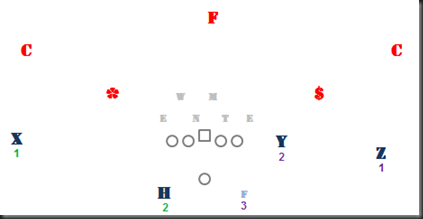 Like we discussed in the earlier TCU 2-Read post, we’re going to narrow our focus on the 3-on-2 matchup to the slot receiver side. When the defense is presented with two split receivers it faces an immediate horizontal stretch (away from the box) while being threatened with a vertical / levels attack.

Fortunately, because of the numbers advantage, there are several ways to play this set between these three defenders (with each having distinct advantages). Keep in mind, the variations listed below could plug-and-play any one of these defenders into a role (hence the multiplicity in how slot is treated).
You could feature 1 underneath force player and 2 deep coverage defenders (sky, cloud, buzz). This could be country Cover 3, quarter-halves, or bracket coverage on the #1 receiver.
You could have 1 deep defender over the top of 2 underneath defenders. This could be anything such as traditional Cover 2, robber or bracket coverage on #2.
Or have 1 deep defender with 1 underneath (seam) defender that could be Quarters (Meg) or fire zone.
Or it could simply be man-under coverage with deep help.
All of these alternatives can be played from one defensive (presnap) alignment, yet create a world of hurt if an offense filtered their throws through defender reads.
A feature of this exposition should be to illustrate how "what TCU does" (in the secondary) is actually what every other defense (NCAA/NFL) does - they both end up in the same scheme when its all said and done. With TCU's patented "3 coverages", you end up with a combination of 9 coverages available (2, Blue, 5, 25, 2 Blue, Blue 5, Blue 2, 5 Blue, 52). All of this is a result of how the slot is played. Whether you are the Horned Frogs, the New York Giants, or the San Diego State Aztecs.....whatever scheme you call yourself playing; you arrive at the same destination.
With this preface set, in the next few posts we will discuss the many different slot coverage adaptations available to a defensive coordinator. We’ll explore how they work within the overall scheme, why it is advantageous to not only treat slot sets differently, but also how to effectively keep quarterbacks guessing when confronted with all the variations the defense can give them.
As we’ve covered before, remaining gap-sound in run-support is a fundamental equation that is addressed every snap based on the formation. In this post, we’ll look to set a foundation of defensive concepts through fragmentation. After setting this ground work, it will be followed with different alternative coverage adaptations available to a defense.
One of the biggest mistakes for those learning the game of football is to fixate on the minutiae of various “brands” of defense. Tying oneself to the dogmatic thinking and going-through-the-motions of “how we’ve always done it” without understanding the rationale of how it all works creates an intelligence rut that becomes a liability. Defenses exist to defense an offense – they do not exist within vacuums. On every play you’re defending something the offense is doing to advance the ball. For this reason, defenses aren’t static entities – they must respond (adapt) to the stimuli they are presented with. You will hear people declare, “we are a 3-4 Quarters defense” or something to that effect. That’s great, but there is a reason a defensive concept is employed on a given down, and there is no catch-all defense available.

Belichick on Defense
“At the Browns we played a 4-3,” Belichick said. “We won two Super Bowls playing a 4-3. In ’01 and (‘04). Second half of the ’01 season, we played 4-3 after Bryan Cox and (Ted) Johnson got hurt.”
“In all honesty, most people thought we played a 4-3 at the Giants,” Belichick said.
“Lawrence Taylor did a lot more rushing than he did pass dropping. He was probably 90 percent of the time, 80 to 90 percent of the time he was the rusher in the defense. Now not every play was a pass, but certainly in passing situations and on a lot of pass plays, he was the designated fourth rusher which really put us in what amounts to a 4-3. I think honestly that’s somethingthat’s a media fabrication. There are a lot of different alignments out there, you see 4-3 teams use odd spacing, you see 3-4 teams use even spacing.”
“Look, you have 11 players,” Belichick continued. “You can put them in various positions. Whether you want to put it in the pregame depth chart as one thing or another I think is a little bit overrated. You play different fronts, you play different spacings and you teach the techniques of your defense and that is what is consistent. The techniques that are taught in the different defensive systems, whichever one you want to talk about, are consistent within those systems.
A defense really just needs to be concerned about offensive numbers (and how to match them) and the offensive capabilities from their alignment.
While touched on a while ago with TCU’s split-field philosophy, the divorcing of the secondary from the front minimizes the detail of checks a defense would need to concern itself with as well as compartmentalizing the teaching method for each player position. While coverage and front remain related by arithmetic, they can become independent of one another and still function together seamlessly.

its nothing but numbers
First things first is to match the front. In every offensive formation you will have 5 offensive linemen, creating 6 gaps for an offense to attack. The defense should have a plan to account for these 6 gaps presented, typically with 6 defenders (i.e. “the box”). If we (continue to) use the 42 Nickel as a base concept (all of this remains true if you’re a 4-3, 3-4, 33, 50, etc), your bare minimum in the box will be 6 defenders that won’t ever have a reason to “break” their alignment because they ARE the box (they are the minimum gaps being defensed).

As more offensive players are introduced into the box, they create additional areas of attack through leverage (gaps). The defense will fundamentally respond by adding more defenders to this area or risk being out-numbered at the point of attack.

Adding an additional back or tight end to the formation creates even more running lanes, necessitating yet another defender into the box to compensate.

All of this becomes a very academic application that generally gives you a clue as to what and how an offense is trying to set up its next play;
- if you get 1-back you’ll have 7 gaps
- if you get 2-back you’ll have 8 gaps
After addressing the numbers in the box, you will have to figure out what you’re going to do with those other guys left in the secondary. For the remainder of this post (and subsequent posts), we will ignore the box defenders and fragment our discussion into the leftovers of the formation.
With 1-back, we’ll have 2x2 (4 immediate vertical threats) and 5 defenders to match them.

With 2-back, we’ll have 3 immediate vertical threats with (essentially) 4 defenders to compensate. With 2-back (or 3x1), you can get away with doing some flexible things to the single-split side without carrying tremendous risk.


Fortunately, because of the numbers advantage, there are several ways to play this set between these three defenders (with each having distinct advantages). Keep in mind, the variations listed below could plug-and-play any one of these defenders into a role (hence the multiplicity in how slot is treated).
You could feature 1 underneath force player and 2 deep coverage defenders (sky, cloud, buzz). This could be country Cover 3, quarter-halves, or bracket coverage on the #1 receiver.

You could have 1 deep defender over the top of 2 underneath defenders. This could be anything such as traditional Cover 2, robber or bracket coverage on #2.

Or have 1 deep defender with 1 underneath (seam) defender that could be Quarters (Meg) or fire zone.

Or it could simply be man-under coverage with deep help.

All of these alternatives can be played from one defensive (presnap) alignment, yet create a world of hurt if an offense filtered their throws through defender reads.
A feature of this exposition should be to illustrate how "what TCU does" (in the secondary) is actually what every other defense (NCAA/NFL) does - they both end up in the same scheme when its all said and done. With TCU's patented "3 coverages", you end up with a combination of 9 coverages available (2, Blue, 5, 25, 2 Blue, Blue 5, Blue 2, 5 Blue, 52). All of this is a result of how the slot is played. Whether you are the Horned Frogs, the New York Giants, or the San Diego State Aztecs.....whatever scheme you call yourself playing; you arrive at the same destination.
With this preface set, in the next few posts we will discuss the many different slot coverage adaptations available to a defensive coordinator. We’ll explore how they work within the overall scheme, why it is advantageous to not only treat slot sets differently, but also how to effectively keep quarterbacks guessing when confronted with all the variations the defense can give them.
Thursday, June 9, 2011
Why Quick?
Since the end of the bowl season I’ve noticed a number of threads on various sites devoted to the quick game. Given the fact that we are living through the “Spread” age in football this hardly comes as a surprise. What is surprising, however, is the number of posts in which coaches speculate as to how relevant a quick game package is to an offense that bases out of the gun anyway. After all, should it not be possible to simply build your quick package into your basic 5 step package anyway, either via hots, sight-adjustments, or some form or the other of flare control?
There are six reasons why one needs to throw quick:
1. Horizontal Stretch
2. Force defensive numbers to be even in the box.
3. Force hard support control
4. Identify the leverage on the perimeter.
5. Find where the defense is not on the field.
6. Blitz control.
I think relationship between reasons one and two is pretty obvious. If you are a spread team, operating in a four-wide environment, the quick game functions as a way to structurally set the defense and to get an idea as to how the defense is going to defend the box. In a sense, your quick package should do for you what double-tight does for an ACE team in that it should force the defense to balance up, which should enable the offense to get a hat-on-a-hat in both the running and passing games. In other words, the horizontal stretch the quick game creates should prevent overloads from occurring in one form or another. In so doing, the quick game also enables you to identify the specific areas in a given defensive structure that you will want to isolate and exploit by way of the five-step game.
In the same way that one and two work together, so do three and four. If you create a good horizontal stretch and even the defense the defense will begin to play hard support, thus flattening the under coverage out, creating, in effect, more man to man situations in which defenders will, by the leverage of their technique, be in a less effective position to play good run support. In addition, this will clarify the defense’s leverage and subsequent pursuit angles.
Reason five, I believe, helps explain why the quick game is an invaluable tool: it helps identify, at early stage in any game, where defenders are and where they are not. In this sense, the quick game is tool for probing that helps an offense identify where along a broad defensive front it should concentrate its spearheads.
Blitz control, reason six, albeit important, is not, in my opinion, the primary reason one should throw quick. Yes, it’s imperative that an offense have the ability to get the ball off quickly off of a short drop, but certainly there are other tools an offense has at its disposal that can not only serve as a blitz deterrent, if desired, but that are a more sure fire way to make a defense pay for blitzing, such as screens, for example.
In a place of a conclusion, I would like to say a word or two about how the quick game figures into the historical evolution one-back offenses. I know this will sound like ancient history, but the one-back offense, as we understand it today, in the modern post-Jack Elway / Pink Erickson sense (and for those that don’t know, Pink is Dennis’ father), developed out of a desire to find an easy and economically teachable way to spread the ball out to the perimeter in order to displace defenders and open the running game. What people forget is that the passing game of the modern one-back offense, the one that Dennis Erickson popularized throughout the ‘80s and ‘90s, but not the one he runs today at ASU with Noel Mazzone, revolved around a vertical stem quick game whose main objective was to create a horizontal stretch that would displace the Sam backer, create a 4-2 box, but one with a two hi shell that would enable the offense to run a power inside and outside zone running game, preferably to the low shade of the defense. So, even in its modern beginnings, the quick game was really not designed as a way to beat the blitz, but rather as means to an end for running the football.
In my next posting, I will talk at some length about the questions a staff needs to ask itself as it conceptualizes its program’s quick package.
There are six reasons why one needs to throw quick:
1. Horizontal Stretch
2. Force defensive numbers to be even in the box.
3. Force hard support control
4. Identify the leverage on the perimeter.
5. Find where the defense is not on the field.
6. Blitz control.
I think relationship between reasons one and two is pretty obvious. If you are a spread team, operating in a four-wide environment, the quick game functions as a way to structurally set the defense and to get an idea as to how the defense is going to defend the box. In a sense, your quick package should do for you what double-tight does for an ACE team in that it should force the defense to balance up, which should enable the offense to get a hat-on-a-hat in both the running and passing games. In other words, the horizontal stretch the quick game creates should prevent overloads from occurring in one form or another. In so doing, the quick game also enables you to identify the specific areas in a given defensive structure that you will want to isolate and exploit by way of the five-step game.
In the same way that one and two work together, so do three and four. If you create a good horizontal stretch and even the defense the defense will begin to play hard support, thus flattening the under coverage out, creating, in effect, more man to man situations in which defenders will, by the leverage of their technique, be in a less effective position to play good run support. In addition, this will clarify the defense’s leverage and subsequent pursuit angles.
Reason five, I believe, helps explain why the quick game is an invaluable tool: it helps identify, at early stage in any game, where defenders are and where they are not. In this sense, the quick game is tool for probing that helps an offense identify where along a broad defensive front it should concentrate its spearheads.
Blitz control, reason six, albeit important, is not, in my opinion, the primary reason one should throw quick. Yes, it’s imperative that an offense have the ability to get the ball off quickly off of a short drop, but certainly there are other tools an offense has at its disposal that can not only serve as a blitz deterrent, if desired, but that are a more sure fire way to make a defense pay for blitzing, such as screens, for example.
In a place of a conclusion, I would like to say a word or two about how the quick game figures into the historical evolution one-back offenses. I know this will sound like ancient history, but the one-back offense, as we understand it today, in the modern post-Jack Elway / Pink Erickson sense (and for those that don’t know, Pink is Dennis’ father), developed out of a desire to find an easy and economically teachable way to spread the ball out to the perimeter in order to displace defenders and open the running game. What people forget is that the passing game of the modern one-back offense, the one that Dennis Erickson popularized throughout the ‘80s and ‘90s, but not the one he runs today at ASU with Noel Mazzone, revolved around a vertical stem quick game whose main objective was to create a horizontal stretch that would displace the Sam backer, create a 4-2 box, but one with a two hi shell that would enable the offense to run a power inside and outside zone running game, preferably to the low shade of the defense. So, even in its modern beginnings, the quick game was really not designed as a way to beat the blitz, but rather as means to an end for running the football.
In my next posting, I will talk at some length about the questions a staff needs to ask itself as it conceptualizes its program’s quick package.
Wednesday, April 13, 2011
Frontline on Football
My brother sit me right down and he talked to me
He told me that I ought not to let you just walk on me
And I'm sure he meant well yeah but when our talk was through
I said brother if you only knew you'd wish that you were in my shoes
You just keep on using me until you use me up
An episode of Frontline (“Football High”) aired last week and it has been making its rounds through the football interwebs and rightfully so. It touches many of the various issues that have established themselves as the fingerprint of our current era of high school football. The piece did it’s best in the short time allotted to address a litany of themes in today’s game that cannot be ignored (despite our best efforts in some cases). Because of time constraints, the editors had to settle for a shotgun-method of presenting these affairs to the public, sacrificing quantity over depth. I wanted to take a bit of space to highlight and briefly comment (I don’t have any answers) on a few of the concerns presented.
- Program Building and the influence of pressure
- Player size consistently increasing to proportions not previously experienced
- Concussions being taken seriously with increased research addressing brain trauma (see links below)
- Impact and the role of equipment to mitigate unnecessary injury - Tom Talavage, Purdue University
- Cumulative effects of small impacts to the head – Dr. Ann Mckee, Boston University
- Safety Enforcement – absence of trainers to professional evaluate athletes (due to budget / lack of regulation)
Player Safety (and the perspective in which we regard coaches)
Watch the full episode. See more FRONTLINE.
“The incentive structure is all wrong.
Coaches are under intense pressure to win games. It’s the only thing that they are judged by. So if you have a player with concussion symptoms and you send him back in the game and has a second concussion, which is always worse than the first, there is no penalty as a coach for that. If you take the kid out of the game and take away the kid’s helmet and you loose the game – there’s a penalty for that.”
- Gregg Easterbrook, ESPN
Easterbrook makes an astute observation here and it was just worth repeating. I found the commentary right before this excerpt more deflating (decreasing availability of athletic trainers), but his point about how we value coaches succinctly captured what this epidemic is all about.
Mega Programs from Mega Churches
At the risk of being offensive and pissing off every reader, I believe there is something here that I feel deserves a closer look. I don’t think there is some boogeyman conspiracy at play, but there IS a formula available (and being used across the Nation) which is able to tie (affluent) money, cutthroat competitiveness, and shameless ego into a maelstrom of domination.

“In the mid-1990s we decided that we really wanted to become a national football program…..and with that everything began to advance…

How do you explain what’s happened here? You have this little football program that has emerged to a national stage. The only way I can explain it is the favor of god – that’s it”.
- Ronnie Floyd, Head Coach Shiloh Christian
But it takes more than divine intervention. It takes money and commitment.
I felt this except from the special was priceless, because behind these benevolent remarks resides something a little more powerful at work than feel-good rhetoric (politics / money / greed). It begets a culture that routinely straddles the line of ethics and the cult of personality. I wrestled with this sort of idea before, where ethical boundaries blur for treatment of players/families through social influence (by invoking the will/perception of the gods). The culture of ultra-win-at-all-costs-competitiveness can be a monster itself to handle, but adding the trump card of god’s guilt (and the petty social politics within any church) is a recipe for abuse.
If you had the means and ability to create the best possible environment for your students, why wouldn’t you? Wouldn’t it be your duty to do exactly that (and why not for your athletes as well)? I am not even one of those guys who begrudges the disparity between public versus private school programs. There are many public schools that are run in near the same fashion. This “formula” that I’m referring to requires a perfect balance which isn’t easy to come by and when lacking oversight from outside parties (away from the self-contained echo-chamber of “win”) it becomes a monster that grows, breeding abuse.
Limitless Potential for High School Programs
“If you’re in a great high school football program, you will spend more time working in high school than you will in college.

Within a full seven day week you have 20 hours to complete all football related activity under NCAA rules. There is not a great high school program in America that does anywhere near that. They’re considerably over that.”
- Walt Williams, Sports Promoter
I don’t know who the hell Walt Williams is, nor can I speak for his title, but everything he explained was dead on the money. This is a subject I’ve shared with my close coaching friends the past few years (especially every time I hear the lazy excuse of “players can’t do such-and-such”). High school football really is wide open on what we can get away with and how coaches can creatively use their time on campus (and off). Again, like mentioned above, it straddles the line of being competitive and being unethical. There are many things we, as coaches, can do to saturate our players with skills and knowledge to build them as players (with little regulation), but finding the right mix between too much and not enough can be a moving target.This all comes back to Bill Withers at the opening of this post. The allure and euphoria that is American football is something that really transcends rational thought. The “football high” (intentional double entendre) speaks to the compulsive nature that is created because these visceral life moments and may not be something we can soberly evaluate like an economic equation. Football, the game, will eat up players and coaches alike without ever returning the ‘love’ / investment made by the participant. The fever of “the game” always comes at a price and something we can all easily lose sight of…. it isn’t the stats, the scores, the wins or losses. It is the relationships with the players and with yourself (what you end up revealing about your own character).
That isn’t to dismiss any of the legitimate concerns presented by this piece (quite the contrary), but for any person who has played high school or college ball and “got it” (the experience), the decision to jeopardize our health and in some cases, peace of mind, is one we wouldn’t even second-guess. The thrill and fulfillment of sacrificing yourself for the benefit of those close to you (and those people sharing alike), to create something bigger than all of you combined is ultimately what this game is about.
Subscribe to:
Posts (Atom)