Wednesday, February 24, 2010

Player Spotlight: Desman Ethridge

2011 Prospect, Desman Ethridge (6'1", 185lbs - TE/SS)
Desman was a 1st team All-District selection at receiver and linebacker in 2009, and put up serious numbers in the weight room last summer ( 245lb power clean, 315lb squat, and a 255lb bench).
Ethridge is looking to pursue engineering after high school.


#21 Desman Ethridge @ Yahoo! Video
Desman is about as easy-going and optimistic as they come and is a great competitor.

Tuesday, February 23, 2010

DASH & ZACK - Developments in Spread Run Game

As discussed previously by Smartfootball and TrojanFootballAnalysis, the advent of spread zone-read running has lead to responding with a counter-punch to defenses that heavily play their fronts away from the back's alignment. Additionally, the "Dash" (or fake Dart) play works great when your regular run game (stretch/zone) isn't working as well (because of smart reading defenders), especially if you don't have a tight end that can block, or you don't want your QB to run all the time.

The team (Oregon) who spearheaded this adaptation, lines the back up a bit further up than regular stretch to create a backward angle of attack. This allows him to widen a flat-footed (reading) playside defensive end.

The QB give-rules remain simple;
  • If the DE flat foots at all (or wrong-arms the kick out), always give the ball
  • If there is any doubt at all (if he comes up to feel / crash), pull the ball
  • ** QB pulls the football if there is any blitz off the edge to the fake
The Dash play has become the perfect compliment to zone running but requires no different practice time. The QB reads remain identical, and no one has to do anything differently. With as little invested, the return becomes pronounced as the defense will be forced to adjust to how they not only defend dash, but also zone and stretch, as well.

This can be run off of regular stretch, and or off of Dart (tackle pull) action.

Running out of 3x1Another great way to utilize this concept is from the leverage of defenders with a 3x1 formation.


If a defense leaves a hole player away from the trips (respecting the common run away from trips), you end up with solid numbers on the perimeter into trips.

If the defense overplays the formation to the trips side, and cheats their hole player over, you end up with great numbers away from trips. A solid block by the single receiver leaves the back on a home run course to the end zone.


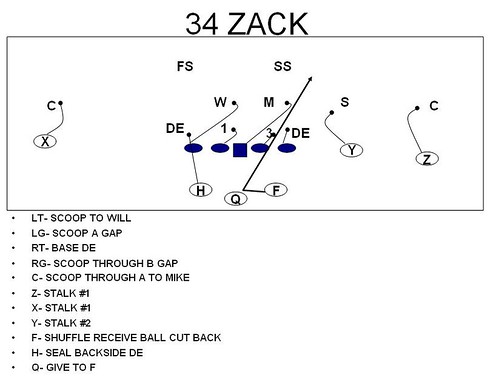
In addition to this key-breaker is the called zone cutback, "Zack".
Another 'cheap' (little time needed to rep this) play that attacks when defenses defeat your base run, this is a 3-step-then-cutback run for the back. This is especially effective when defenses overplay their fronts away from the back (antipating runs to them).

Michigan Fire Zone

As discussed previously, here is just another look at the do-everything fire-zone concept of Sting and Bark. Heavy hat tip to coachhuey’s captmccrae and Aztec, whom I learned this package from years ago.
The basic premise is a hard 5-man slant with a safety walked down creating an 8-man front. This is a prepackaged pressure and can be called to or away from strength.

As the clips illustrate, you can run these against run and pass, and is a very good pressure package against both. These are perfect against 2-back sets and will force offenses to rely on their quick game or leave 7+ in for protection.

These pressures, largely accredited to Dick LeBeau in Pittsburgh/Cincinnati days, were a staple of the Monte Kiffin Viking/Buccanneer defenses. As you’ll see his use of explosively quick interior linemen (Warren Sapp, John Randle, Booger McFarland, etc) accentuated their talents for movement and aggressiveness.


BARK

Seen this before somewhere? Yes, you have....
This is a defensive line slant AWAY from the TE from an Under front, with linebackers playing back strong. The slant will always be run to the 3 technique side of the front and the safety TO walks down. This is a great run blitz, as the MLB aims for the B gap chasm created by the sticking End (inside) and the SLB outside the TE. The WLB slow plays the flow, looking for cutback.

This stunt is run to the 2 receiver side, not particularly strong or weak. The SLB will always run the blitz. The MLB has a key blitz, meaning he is reading flow, as he’ll abandon his blitz if the back flows away. This reaction actually helps the timing of the blitz, as it delays him for a second so the stunt of the defensive end helps clear his gap assignment.

On action to the perimeter, primary contain is handled by the “Bronco” defender who in this case was the Rover and backside end.

The “Bronco” is a seam to flat technique, and relies heavily on the ‘pattern-match’ principles discussed at length on here before. When you are in 3 deep - 3 under, your players just can't just spot drop with your seam players. The bronco player must rally to get on top and match #2, or the seams (of 1-high coverage) will be exposed.
  • If #2 goes vertical, he should match and carry (vertically).
  • If #2 flattens (heads outside), the Bronco player should drive through the curl to the flat.
  • If #2 goes under, he cuts him and looks to rob #1 underneath.
All of this is nothing new to teams that already pattern-match, and the 'parts' become interchangeable. This methodology opens the door for ANY player to now become a Bronco defender, leaving pressure combinations limitless.
STING


You may have seen this concept before here.

Categorized by a defensive line slant TO the TE from an Over or Under front with the linebackers playing back weak. Strong Safety and MLB are blitzing – safety to callside A and MLB to the backside A, the Nose creates the space by sticking to callside B.

This is a particularly effective run blitz as you get immediate inside pressure, with edge defenders slow playing perimeter action, leaving the WLB in the hole (reading back flow) to clean up anything underneath.

Monday, February 22, 2010

Pass Rush (IA Hawkeyes)

Continuing a theme from the Hawkeye Defensive Circuit, here are clips of fundamental DL work courtesy of Ron Aiken;

Be sure to check out previous DL entries here , here, and here.

Friday, February 12, 2010

Dykes in Ruston

Dykes in Ruston

by Jimmy Watson


excerpt;
Q: What type of offensive philosophy do you plan to employ?
A: "When you start a football program, the first thing you have to do is consider how the offense and defense works together. That's something that gets overlooked a lot in football where people might have an aggressive, attacking offense and an on-your-heels defense. So what you want to do is if you want to play aggressive, attacking football you have to do the same thing defensively. Then do the same thing on special teams. So that will be our philosophy "» to attack and try to play with speed on both sides of the ball and special teams as well.
"We walked into a fortunate situation here with (Phillip) Livas being such weapon in the return game. That will be a huge emphasis for us in trying to find ways to get him the ball. There's nothing that can change a game faster than a big special teams play. I know that's a strength of our football team already.
"We want to play disciplined football "» be assignment sound on both sides of the ball. Be smart and limit penalties. Be able to execute. At the end of the spring we need to be able to feel good about operating a base offense and base defense. Our challenge will be to get our kids on the same page and we need to do a lot of teaching in the spring, but we also need to spend a lot of time working on the fundamentals."


Q. As a BCS offensive coordinator, have you spoken with other coordinators about schools at Tech's level and positions that come open as possible landing sites?
A: "As a first-time head coach, you tend to gravitate toward people who share your philosophy. We used to call it the 'One-Back Clinic,' Which is archaic because now pretty much everyone is one-back. In 1997 we started this deal when I was at Kentucky, we went out and saw Mike Tice when he was at Washington State started the 'One-Back Clinic.' Hal Mumme was there. Gary Crowton was there. Kevin Sumlin was a young coach at the time. Chris Hatcher was there. Tony Franklin was there. Mike Leach was there. All these different guys sharing ideas with each other. At that time, we were kind of the outsiders of college football. The game has changed so much that a lot of us are now the norm. We've talked through the years."


Tony Franklin to join him soon as the Offensive Coordinator
SIDEBAR