Friday, August 13, 2010
.........
Tuesday, August 10, 2010
4D-FTP Review
The first DVD outlines vocabulary and terms that Coach Mark uses to orientate the players with this concept. I wasn't entirely sure this truly was necessary and some of it was reinventing the wheel when it came to terminology and segmenting the field. I watched the entire first DVD intently and never saw the payout.....meaning, I could have skipped it entirely and not have lost any value. Okay, so with that....it essentially becomes a question of "is ONE DVD worth $55?" Well, I probably would say yes, simply because this is a good and valid technique to teach. It would be an investment because I am not convinced (nor does Coach Mark suggest) that this is just something you could install in a spring and have down. This is something I would feel comfortable with introducing at the 9th grade level and progressing a player through the program.
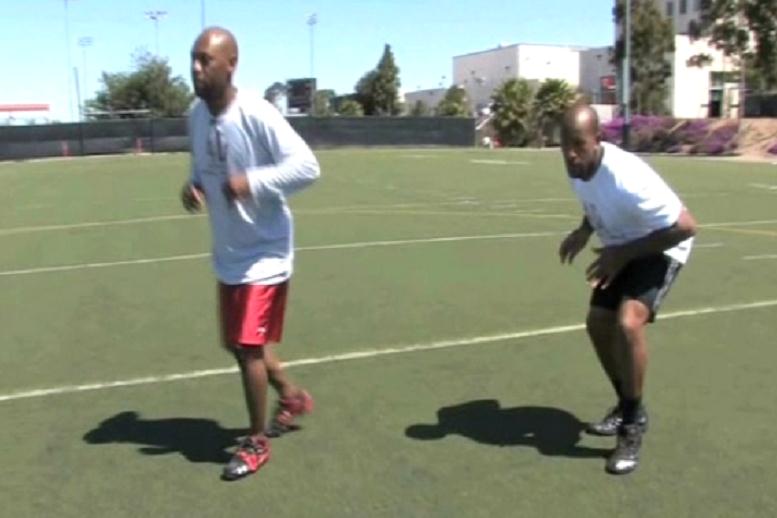
I was much more impressed with the second (drills) DVD. This DVD does a nice job breaking down the basics of the 4-D and provides drills for working on 4-D skills. From basic drills on change of direction to playing the 3-step game and fade routes, the DVD goes through the 4-D progression in good detail.
One thing that we may take from this presentation is utilizing the drift step for changing direction. I'll be watching over and over again until I get this down. I can certainly see the technique actually being superior to shuffle in terms of biomechanic efficiency and certainly more fluid than T-stepping. The only concern would be the expense it would take to get good at it (compared with shuffle). You could be good at the shuffle in 5 minutes (then spend significant time concentrating on not being sloppy) - it would take significantly longer to make 4D (or just the crossover steps) a natural act for average athletes.
The 2nd disc was really nicely done and is high quality (except for some unexpected video breaks? in the bp portion). I would have preferred more specifics on foot placement and body positioning (coaching points to make sure kids avoid common errors). Also, it may help to show how this technique would apply to various coverages. This would be perfect for guys who run their defense like "you cover that guy" and mash various concepts together. This would be something to get started on in spring ball and really just hammer every day, giving something for the kids to use heading into summer passing leagues. Because the transitions taught are directly related to what coverage (leverage) you are playing, it would be nice to articulate in subsequent offerings / clinics how this would adjust and adapt.
I applaud coach rodriguez for presenting these materials and helping the game with an improved technique. The video quality IS top notch, I just wish there was more that we could apply towards coaching the specifics of the technique.
Order at
http://myonlinecamp.com/camp.cfm?CampName=&sport=24&city=&state=IA&pricerange=&start=1&id=10015
Monday, August 9, 2010
Return of Football
Roll Tide
http://dailybamablog.blogspot.com/2010/08/video-new-defensive-backs-work-with.html
http://dailybamablog.blogspot.com/2010/08/video-offensive-line-at-friday-practice.html
Saban-Man-Crush continues at....
http://dailybamablog.blogspot.com/2010/08/fan-day-videos-part-i-defense.html
Friday, August 6, 2010
BRONCO/SCIF Player
The 5-man pressure package can seem complex or superfluous to many folks, treating it as an alien concept. If you already pattern-match from a MOFC, then adapting to the fire zone for your players and philosophy becomes a natural extension. When players understand zone coverage as it relates to pattern distribution, plugging and playing them into similar roles becomes feasible because of the shared skill set.
When running a fire zone from a coverage standpoint, not much will actually change in the secondary. The fulcrum to this scheme will fall on the integrity of the SCIF/Bronco player, who controls the seams and matches the second receiver in the distribution. This player can be anyone within realistic alignment position (safety, linebacker, defensive end) near the seam. The beauty of the fire zone is its flexibility, you can bring anyone to match / fulfill the 3 underneath players.
If the SCIF player is a member of the secondary, the adjustment is extremely simple. If it is being run out of a 3-man / odd front, there usually is no need to drop linemen to create a fire zone, so you would typically end up with a Dog, Backer, or Safety as the SCIF player. Whoever it may be, the rules and technique will remain the same. The goal is to control the seams, the area between 2 yards inside the hash extending out to the numbers. You are essentially expecting a sack or force a short throw (below the conversion down) and outside (difficult).
This SCIF player must control the seams, which will be immediately threatened by the #2 receiver. On the snap, the defender will keep his eyes on the quarterback, bounce his feet (much like a Cover 4 safety), and easy pedal out with a slide step. Once recognizing drop back action from the quarterback, his eyes will snap to the #2 receiver and continue to slide for depth to stay on top of #2 at a depth of 10 yards.
Because this is a pressure package, the throw, if it occurs, should be quick (under 2 seconds) and not allow the quarterback much time to process through his progressions. If the quarterback's shoulders are directed at the seam, the SCIF player should be expecting an inside or vertical route, to which he has out leveraged the receiver (eliminating the throw). The SCIF defender should know that once the quarterback's shoulders go OUTSIDE the seam (exaggerated toward the flat), there is no way for him to progress back inside (and even if he did, the 'final 3' player would handle it). Therefore, if the quarterback's shoulders turn outside the seam, the SCIF should work parallel (expand width) to the numbers (sideline).
- If #2 pushes vertically on the seam, the SCIF should catch at 10 yards and carry. He is essentially looking to play 'catch' technique on a vertical stem by #2 with inside-out leverage.
- If #2 runs a speed out, the SCIF should slide to his outside foot and bust to the curl route, expecting the #1 receiver to be there on a curl-flat combo. The SCIF should not jump the speed out (but anticipate #1 will be the #2 after the pattern distribution).
- If #2 breaks inside (shallow) underneath 10 yards, the SCIF will attempt to deliver this receiver to the final 3 player in the hole with an outside leveraged collision.
- If the quarterback's shoulders open AWAY from the SCIF player (he is backside), remember, the quarterback won't have time to work back inside, the SCIF should slide parallel inside, no further than 2 yards inside the hash and help squeeze the ball with the 'final 3' player.
Where things get dicey is when you involve a lineman (end) in coverage as the potential dropper / SCIF player. This really becomes a run stunt because being away from the pressure overload, the defensive end's interior linemen will be stunting to his side. The nearest lineman will be looping to his "C" gap contain responsibilities, leaving the SCIF defensive end as a potential "B" gap filler. Below are some reinforcement drills on how the SCIF DE will mirror the back (load/flare) with leverage. The SCIF DE should always think of himself as a run-player FIRST, and a dropper only if there is no run action by the back.


