Showing posts with label NFL. Show all posts

Monday, November 23, 2015

Coup d'œil

Inspired by the insightful post of Alex Kirby at Life After Football , I wanted to offer feedback on this same process with an emphasis on developing a routine for interpreting live football broadcasts. The method I'll outline is one that I've used for years while being in the box for gameday communication.


What we'll outline here is how to assess the next play that is going to be run before that play starts.  The beauty here is this is a skill you can hone with hundreds of reps at your leisure. Likely, you will already be watching 12 hours of football each weekend that you can practice with.  Let's assume you watch 3 or 4 football games in a weekend. That translates to roughly 450 - 500 repetitions to train your brain with instant feedback to develop this skill. This allows you to stay engaged with any broadcast, playing this game (within a game broadcast) but also developing a skillset invaluable to football coordinating.  Watching games dispassionately, just focusing on formations and areas of the field,  allows you to develop an intelligence towards predicting outcomes.  Naturally, the type of plays called will depend on the play-caller, but those become exceptions to the rule.  The more you exercise this technique, the more scenarios you will have to draw from because you will receive instant feedback once the play is run (were you right or wrong? What did you learn from your hypothesis?).


When all is said and done, it really is the commander's coup d'œil, his ability to see things simply, to identify the whole business of war completely with himself, that is the essence of good generalship. Only if the mind works in this comprehensive fashion can it achieve the freedom it needs to dominate events and not be dominated by them. -Carl von Clausewitz 

Monday, March 11, 2013

The Complete Guide to Downloading the "All-22" NFL Film

First let me start by saying I’m extremely humbled to be a contributor to what I believe to be the best football blog out there. I’ve been reading this site for some time, so to be able to add to the discussion on this site is something I’m very excited about. I want to thank Brophy for allowing me to be a part of this great teaching tool for coaches and football enthusiasts alike.

If you’re anything like me, one of the great moments in your lifetime had to be last year when the NFL announced that it would be selling a subscription service to view the ‘All-22’ film used by coaches. I, like many other people, doubted this would ever happen, but I have never been happier to be wrong.


Now, like every other coach in America, you’re probably wondering just how to get your hands on this film, and even more importantly, how to download it to your computer and burn it to DVD and/or cut it up.

I’m going to approach this from a couple of different angles, because I’m sure there are plenty of you who are reading this who may not be working with a high school or college program. Maybe you just enjoy watching football and doing your own research and study of the game. In that case, this post will be perfect for you, because I’m going to show you a lot of low-cost and/or free resources that you can use to make every cut up you could possibly imagine. Ideally, you should be able to make all this happen for between $100-$150, assuming of course that you already have a computer and a reliable internet connection.

On the other side of the coin, if you happen to be in a program with access to breakdown and editing software like Hudl, LRS, DV Sport or even XOS, then you’ve got a lot of potential issues already taken care of for you, and it will be a much easier task to get the film you want and manipulate it however you want.

One final note, some of the details mentioned here may seem elementary to some of you, but my goal was to make this accessible to coaches who may not be the most comfortable with computers. If I was unclear on anything, or need to expound on something, please let me know in the comments.

Part 1 - What You’ll Need

NFL Game Rewind Season Plus

Yes, unfortunately there’s no (Legal) way around getting access to this subscription, unless you just happen to work at NFL Films. The NFL has come down on it drastically, selling a subscription that will give you access to all replays of TV copies of games for the past four seasons, as well as the past two seasons worth of coaches film. As of the writing of this article, the cost is down to $24.99 from its original price of $69.99. The subscription lasts until July 31 of this year, but twenty five bucks for six months of access to coaches film is a bargain if you ask me.

You can buy a subscription here.

Stream Transport

This completely free stream capture software is a program that use all the time. It takes seconds to download and install and is extremely simple to use. We’ll get into the details later, but make sure you have this installed before you try to download anything. For those of you familiar with programs like Replay Media Catcher, this works just as well, and best of all like I said, it’s completely free.


For those of you who like making YouTube videos (Like I do), this program is capable of capturing video from plenty of sites, such as ESPN3.com.

There are a couple caveats to using this program. The first is that it appears to have fallen out of development. In other words, everyone on the internet is constantly updating their minimum requirements for internet browsers, and the makers of Stream Transport don’t seem to have put out an update in over a year. It uses Internet Explorer as its browser, which is bad enough, but when you factor in that it’s a version of Internet Explorer that was phased out over a year ago, it can be a pain. There will be a day in the near future when this program is no longer compatible with most modern websites, and once that happens, people will just have to purchase the aforementioned Replay Media Catcher.

The other downside to this program, and stream capture software in general, is that it works in real time. In other words, if you’re wanting to download a game that’s 90 minutes long, it’s going to take 90 minutes to capture and save it to your computer. I have yet to find a program that doesn’t work in ‘real time’, but if anyone knows of one, please leave a comment below.

The program is available for download here.

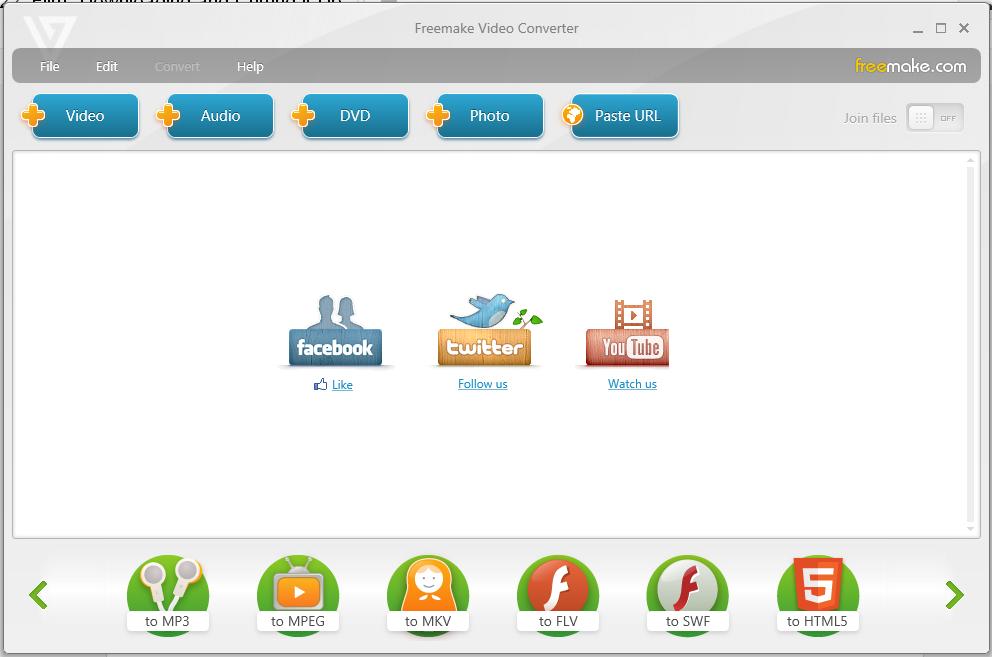
Freemake Video Converter

As you probably guessed by the name, Freemake Video Converter is another free software program that I use almost daily. This program is great for burning DVDs, and converting videos from one format to another.


Freemake has a list of all of their downloadable programs, including their video converter, here.
RealPlayer


NFL.com encodes all the coaches film in Flash Video format, which is identified by the “.flv” file type. For those of you who download a lot of videos off the internet, this is not news, but there are still plenty of computers without the ability to play these type of videos. Depending on what version of Windows Media Player you’re using, you may not be able to open these files.


I recommend RealPlayer as your go-to video player. It downloads in seconds, it’s easy to install, and best of all it’s free.

(Read through the options carefully during the installation, or you may end up with some free programs you don’t want or need.)


The latest version can be downloaded here.

VideoPad Video Editor

I’ve been using this program for a couple years now, mostly for my own personal projects, and I haven’t found one I like better in the same price range. If you have a video editor that works for you and that you’re comfortable with, then great. What’s important is ease of use and the ability to cut up and convert quickly to whatever video format your system uses.

Also, if your team happens to use Hudl or some other tool you feel comfortable using to cut up and edit film, that will work just as well.


You can download the program here.

External Hard Drive

Depending on how much you’re looking to download and what kind of storage you have on your computer, you may want to look into buying an external hard drive of some kind. Prices vary, but usually a decent 1 Terabyte (1024 GB) hard drive will run you about $100. If you’re serious about putting together a good film library, then it's a very good investment.

Part 2 - The Process

Assuming you’ve already purchased the NFL Game Rewind package with access to the ‘All-22’ film, it’s time to get started.

If you’ve never used Stream Transport before, it may seem confusing at first, but we’ll be covering everything you need to know about the program in this post, so no need to worry.

STREAM TRANSPORT

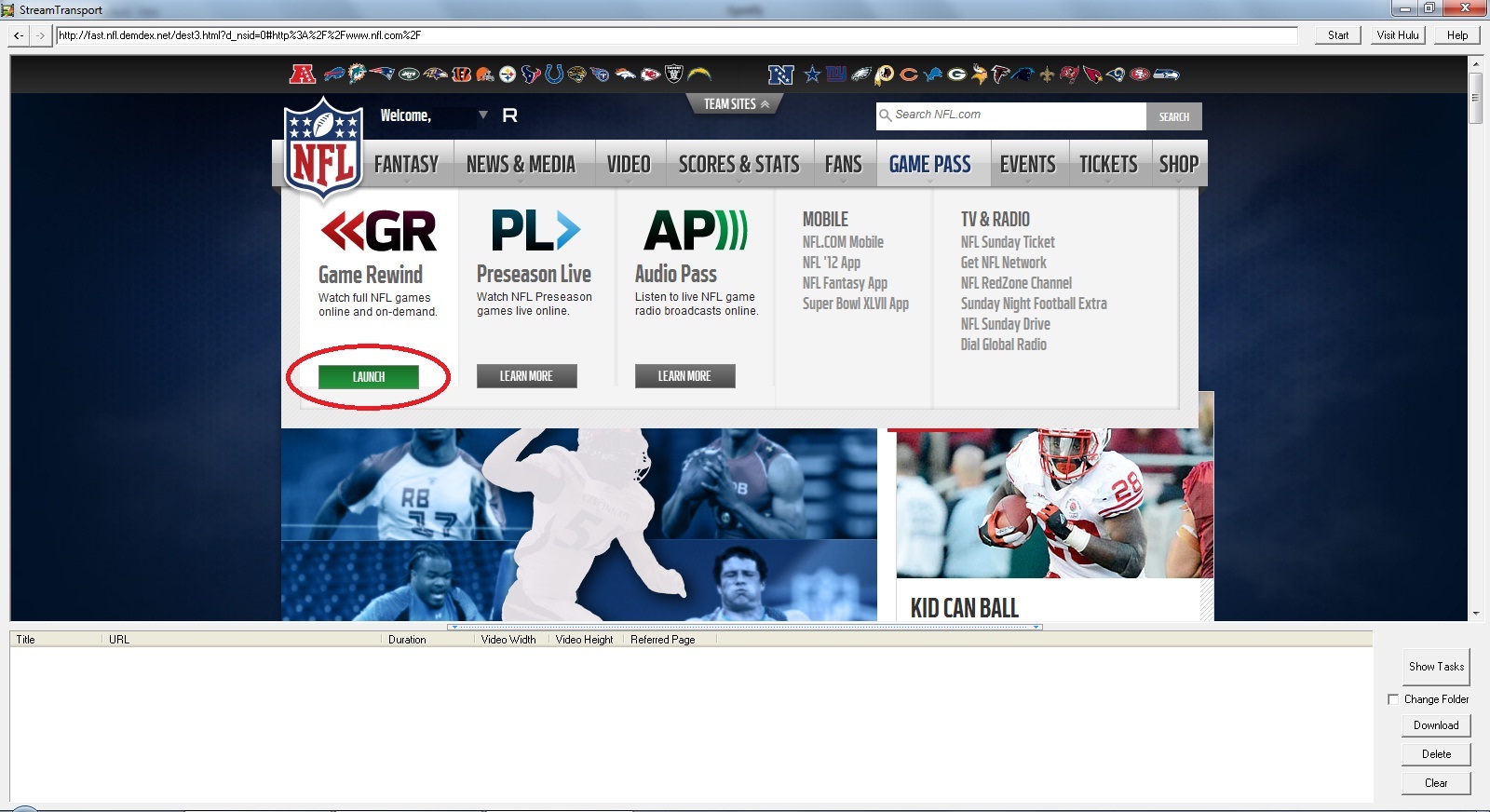
To begin, open up the ‘Stream Transport’ program, and type in NFL.com into the address bar. It’s important to note that Stream Transport uses Microsoft Internet Explorer as its default browser, the only major fault I can find in the program. (Hopefully the developers switch to something like Firefox or Chrome if they ever decide to put out an upgrade)

Log in to NFL.com with your account, and find the Game Rewind tab, and click ‘Launch’.

Once you’ve hit the ‘Launch’ button, a screen like the one below should pop up, with the previous week’s games listed. You also have the option to scroll through the past four seasons with the year and week boxes above the ‘Watch’ button. Keep in mind however, that coaches film is only available for the 2012 and 2011 seasons.

Since I’m writing this in the middle of February, the last game played was the Super Bowl, so let’s click on the ‘Watch’ button.

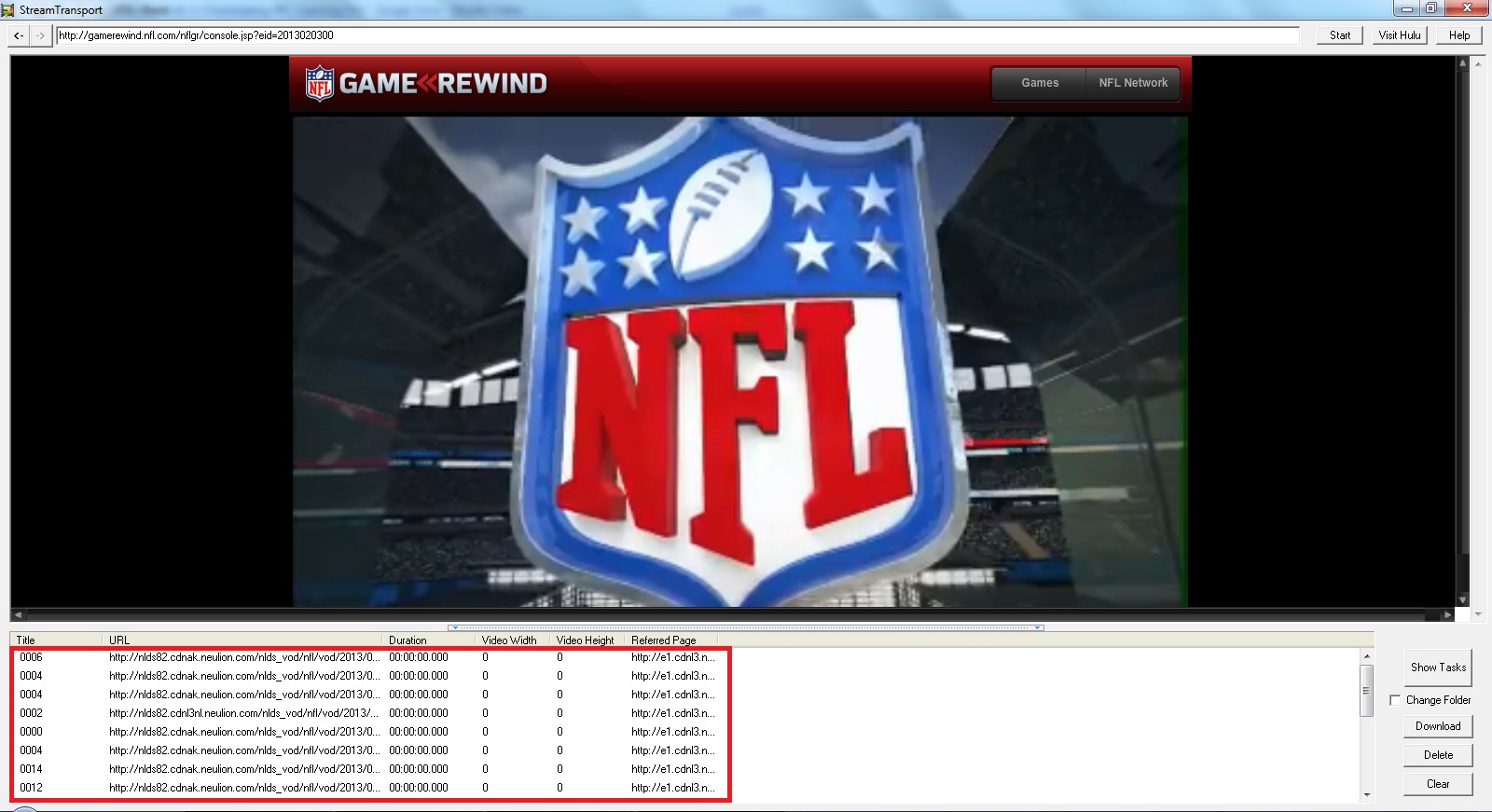
As soon as the game loads up, an edited version of the TV broadcast will start playing, and you’ll begin to notice some stuff start popping up in the bottom box. You should pay attention to the columns labeled ‘Duration’, ‘Video Width’ and ‘Video Height’. As you can see, the duration for all these files that have popped up is zero.

What the NFL has done is sliced up the TV copies of the games into tiny, one second-long clips that would drive Russell Crowe in ‘A Beautiful Mind’ crazy if he tried to sit there and piece them all back together. Luckily, the NFL has decided not to do the same thing with its coaching film, otherwise I’d be sitting on the floor of my office in the fetal position after piecing together a Peyton Manning offensive drive from this past season.


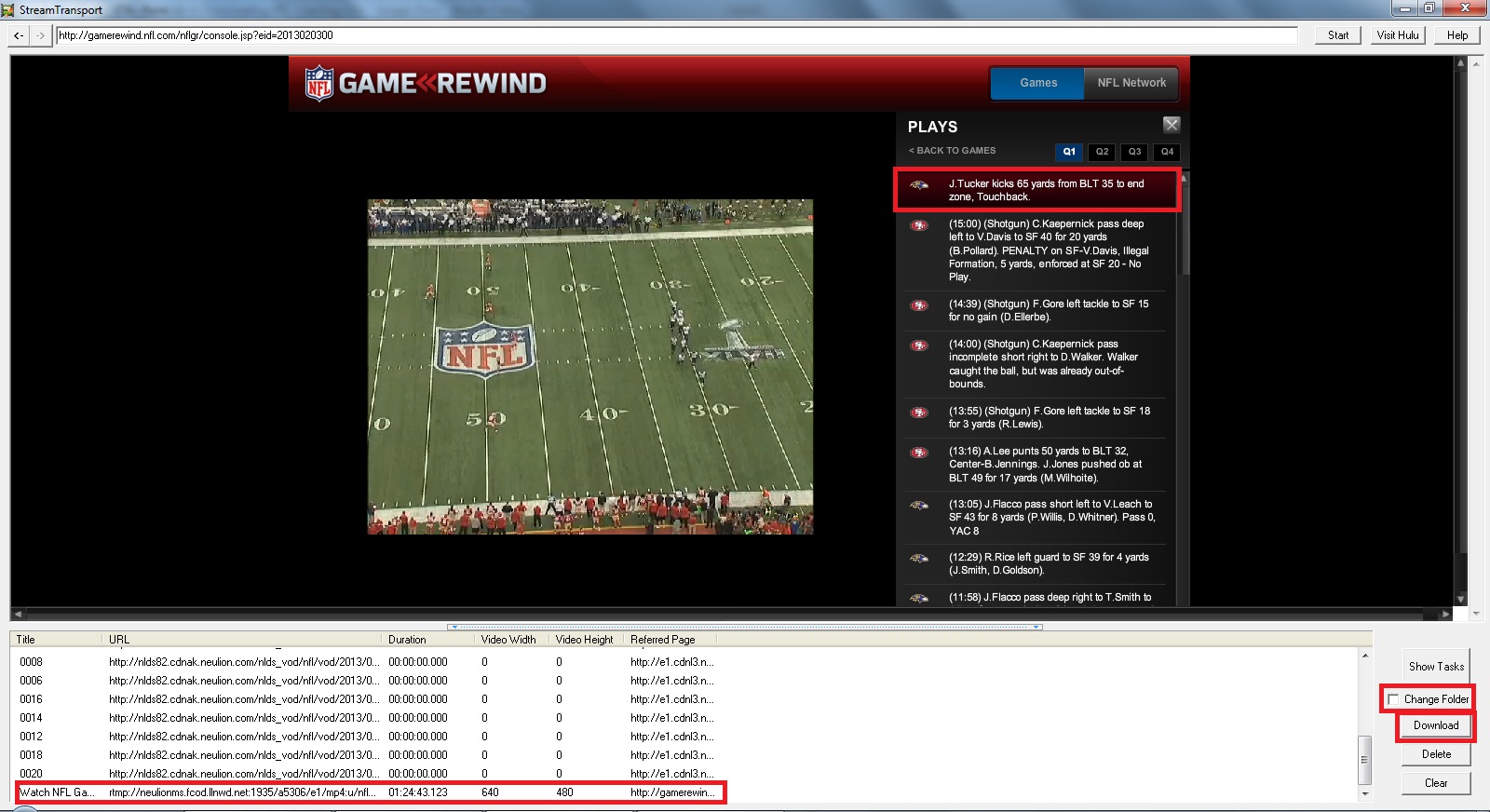
In order to get to the good stuff, move your cursor over the video itself, and there should be three different buttons that pop up, including one that says ‘Coaches Film’. Click on it.

At this point, you should see a scoreboard come on screen, followed by a wide angle shot of a kickoff. NFL.com stores all their coaches film in a ‘Full Game’ format, that means no ‘ODK’ for you college guys. If you want that you’ll have to cut it up yourself. Congratulations, you’ve made it to the promised land, this is what you’ve all been waiting for.

You should also notice in the bottom box that another file has popped up, this time with an actual duration and video height and width. This is the file you want to download. Most downloads average a little over an hour long, but the good news is that they are stored in the compact .flv (Flash Video) format, meaning that 1 hour = approximately 1 GB of storage.

If you’re like me, and want to download as much as possible, you’ll have to get an external hard drive (see my earlier comments on external hard drives).

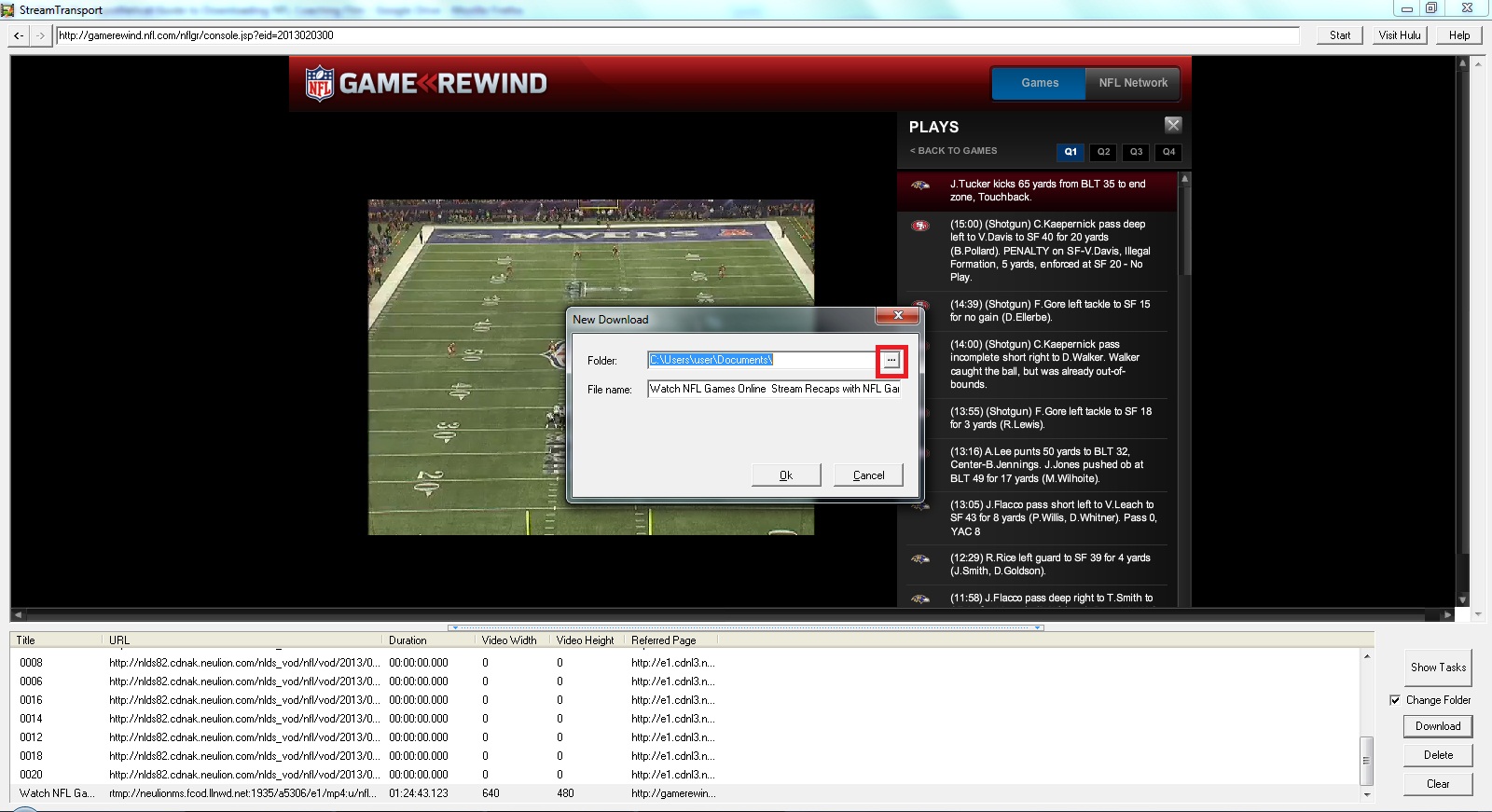
Once you’ve highlighted the file, check the box labeled ‘Change Folder’, then click ‘Download’

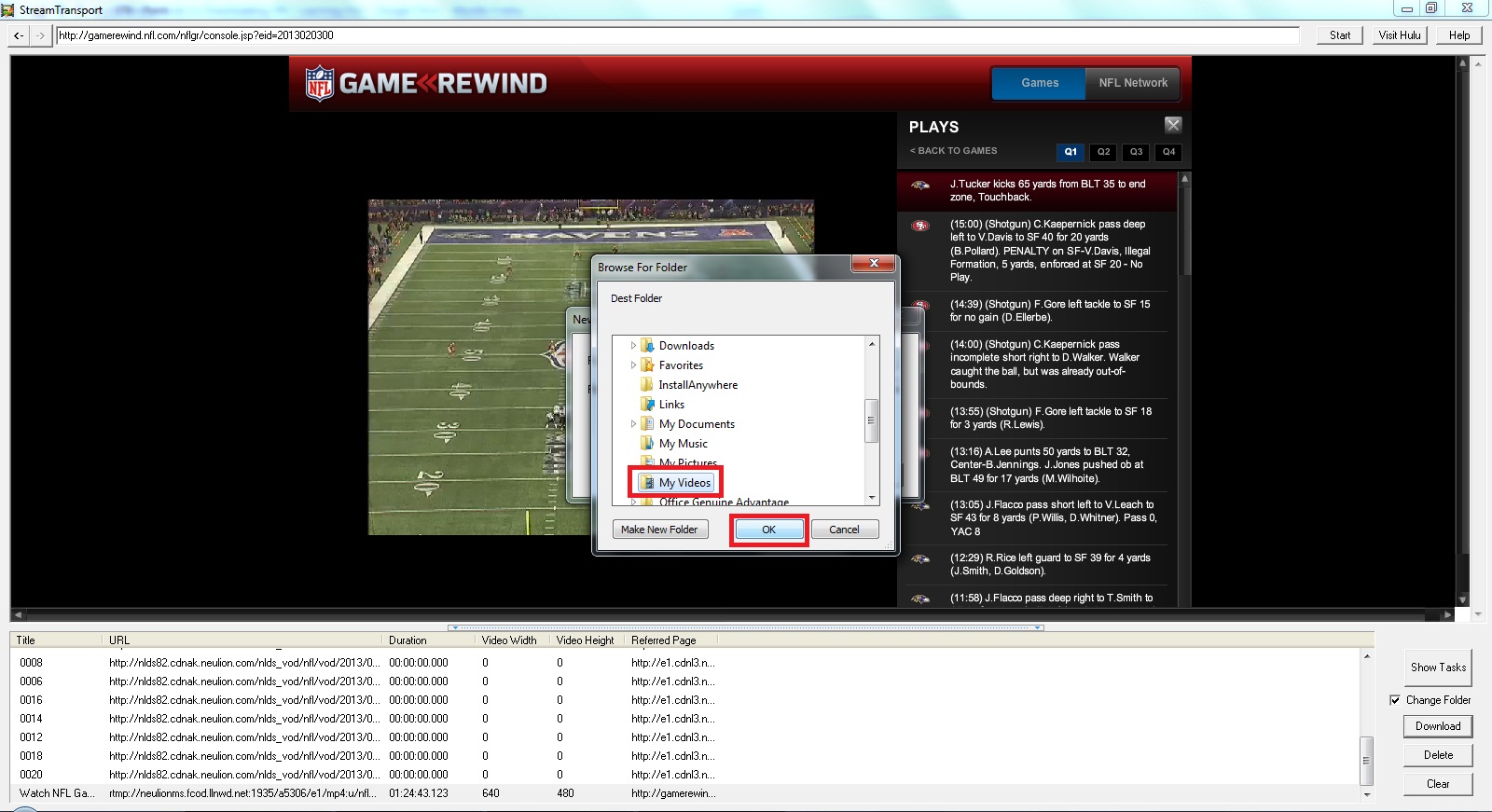
You’ll then have the option to pick where you want to save the videos. I’ve chosen to save them in the “My Videos” folder.

You’ll have your pick of where exactly you  want to save it. You can even create a new folder if you want by clicking the “Make New Folder” button.


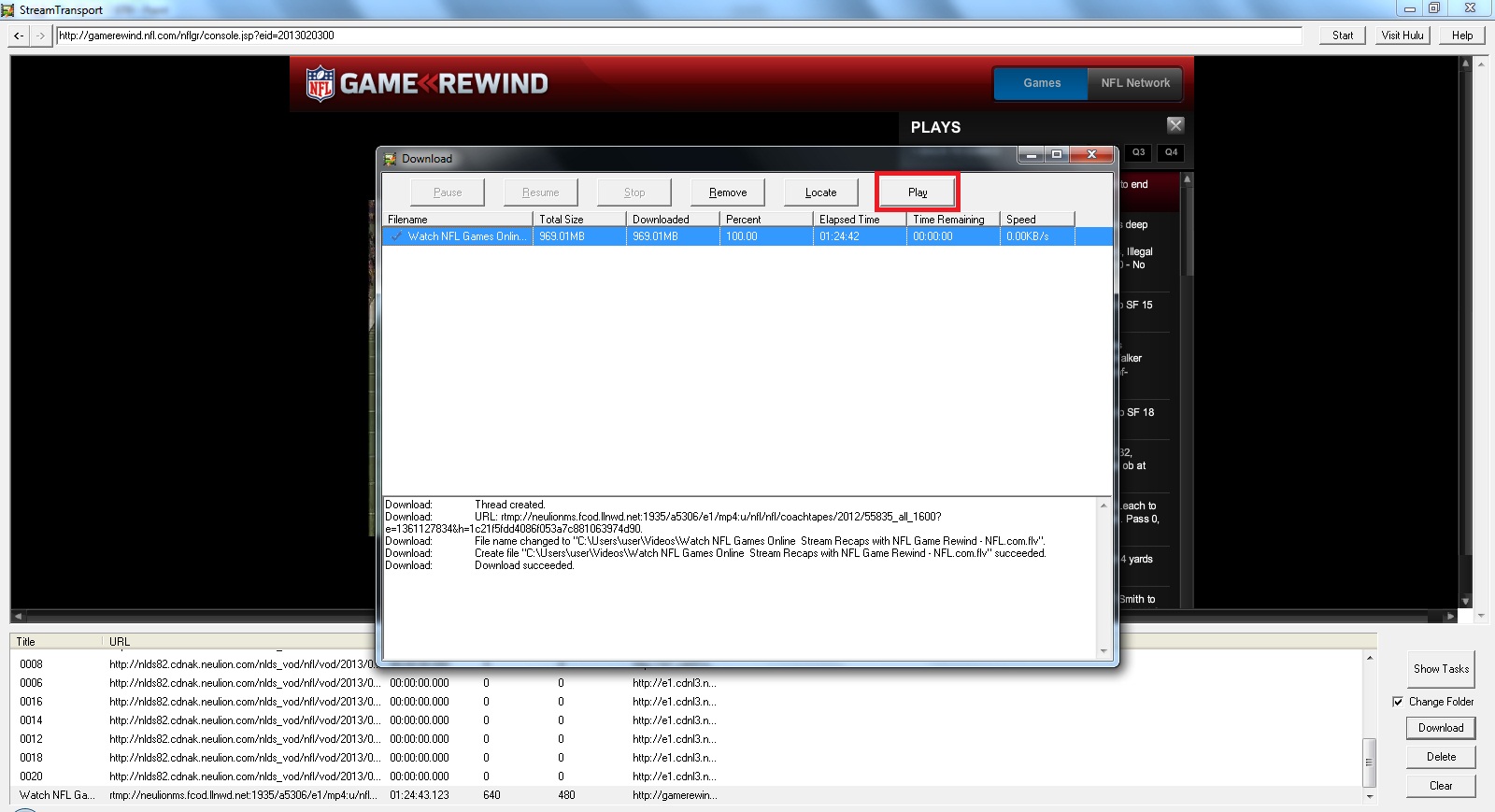
Once you hit the ‘OK’ button, you should see a download box pop up that looks like the one below. It’ll give you a progress report, and you can download up to four videos simultaneously. Once again, you’ll have to download everything in real time, so just minimize the program for about an hour and do something else while it finishes.


Once the download has finished, you can hit the ‘Play’ button to watch the video.


A FEW ASSORTED FINAL THOUGHTS

For best results when burning a DVD, you’ll want to use Freemake Video Converter to convert the .flv files to .mp4 format, since it is the format that most easily converts over to DVD.

Some of you may have the ability to burn directly from whatever film editing program you use, and as long as you can successfully import it into your program, you shouldn’t have much trouble burning it to a DVD.

One thing I must caution you to absolutely NOT do is to post this video on YouTube or any other video site for public consumption. The NFL is one of the most trigger-happy organizations around, and they are constantly patrolling the internet for copyrighted material that has been posted without their permission.


I hope this post has been helpful to you. Please pass it along to your friends in the coaching profession who are interested in getting access to the film. If you have any questions or comments, please leave them below, or feel free to shoot me an email.


Alex Kirby
Video Coordinator
Indiana State University
 

AKirby7@sycamores.indstate.edu
@AlexJKirby

Tuesday, January 29, 2013

Future of Football


I attended an interesting debate regarding the (legal) future of football at Tulane the other night.  I find the changing landscape of the sport an interesting study that attempts to balance perception, neuroscience, liability, performance improvement and [game] fundamentals.  This discussion attempted to focus on using "what we know now" about the physical impact of football participation with the financial recourse of the NFL (and more importantly the 32 franchises that assume legal risk) and how this will shape the game in the coming decade.

DISCLAIMER: For what it's worth, I really don't have any preconceived notions on the issue. I find the NFL's legal finagling (and analyst reviews of hits) unrealistic, though I do understand the position they are coming from.  What interests me most is understanding the physical toll of the game, particularly in areas we have been ignorant up till now. I think we all would like to ensure the safety and well-being of players.  I don't see this impacting how the game is taught; an emphasis on proper fundamentals (separation/extension in line play - striking with the chest in tackling) has to be grounded in everyone involved.  This does not make the game less violent or aggressive. However, this issue is certainly bigger than collisions and contact.  Examination of these trends cannot be addressed with singular solutions, thus requiring us all to get the full picture and keep an inquisitive open mind.  It's also important to delineate our emotional response to providing safety to the game; blowing out a knee is worlds different than bruising your brain.


The event was moderated by Tulane Law professor, Gabe Feldman, with panelists Andrew Brandt (ESPN), Mike Pesca (NPR) and George Atallah (NFL) and delved into a very academic discussion of where the game's current momentum is leading it. Steve Gleason and Scott Fujita also joined in the dialogue.  

Yes, it is NFL-centric though the trickle-down impact and dilemmas are brought up late in the discussion.  Also, the "bounty" issue is belabored a little too long at the opening remarks.  That being said, this was an extremely worthwhile and mature discussion without the typical rhetoric.

Short rundown of discussion points:

  • Bounty Issue
  • Safety of the playing game vs ethics of watching the game
  • Role of the player union in ensuring a safe work place
  • Safety vs the momentum of revenue
  • No one solution to CTE issue; exploring how to reduce it
  • NFLPA's role in championing safety and influencing the NCAA 
  • Role of a football player's in society
  • Safety rules are lopsided against defensive players
  • Dilemma of PED testing in the NFL

For audio only - listen/download here > "Future of Football @ Tulane Hillel"


For video - please visit Robert Morris' work at the Uptown Messenger 


"Regarding the evolution of the NFL, I believe the greatest asset the NFL has is the talent. The game will not, in my opinion, change because of viewers or governance.  The evolution of the game will come from the talent pool.  The safety measures, despite comments like Pollard's have primarily come from the talent pool (the players).

I do not feel the viewers will ever stop watching because they are put off by violence.  More likely, the talent pool will diminish because a six year old kid says he wants to be like Junior Seau when he grows up.  Now that kid and his parents do not want to grow up like Junior.  As a result, the talent pool has diminished, and thus, the game slowly becomes less relevant.  Obama, with his hypothetical comment, in his own way, diminished the hypothetical talent pool, which again, is the greatest asset the NFL has."

-Steve Gleason


UPDATE: Another timely piece that is worth reviewing


related:

http://www.aspeninstitute.org/events/2012/11/09/playing-safety-future-youth-football

http://theconcussionblog.files.wordpress.com/2013/01/nfl_notification_02.pdf

http://www.pbs.org/wgbh/pages/frontline/concussion-watch/

http://www.theatlantic.com/entertainment/archive/2013/01/the-nfls-response-to-brain-trauma-a-brief-history/272520/

http://davepear.com/blog/2013/01/that-new-nfl-neuro-cognitive-benefit/

Thursday, March 15, 2012

dusting off the cobwebs of this thing…..

now with more aggro!!!

This post has been on the shelf for a while, so forgive the incomplete thoughts…..

I apologize for the extended break here, y’all. I’ve been unplugging on a sabbatical and really just taking a step back from everything.

I don’t watch television anymore, but every year at this time is always filled with stimulus for the football junkie to crescendo into the climax of the NFL Draft. It is the Senior Bowl, the Scouting Combine, then the Pro Days, then the Draft. An exercise in marketing, hype, and metrics with the benefit of stoking the next great insight into the ‘missing piece’ or next Hall of Famer in the NFL. This lust for the prized champion is probably best epitomized with the drafting of Ricky Williams (tunnel vision to a must-have player).

What I’ve always been amused by was the impact of group-think / mass-appeal when it comes to stories catching fire and raising the stock of a player’s worth. Whether it is Warren Sapp’s marijuana test or Cam Newton’s comments on being an “entertainer”, the slightest crosswind in the pony show can result in a six-figure imbalance all because of a change in personal opinion.

Continuing the diatribe of irritation previously, where flash carries more impact than substance, the amusing meme of Vontaze Burfict. Burfict’s “flash” on the field was exemplified in aggressive junior high antics (making a scene for the cameras), but making few plays as a linebacker. What has been interesting over the course of two seasons is how this ‘performance’ has been interpreted by hacks “analysts”. This type of hype snowballs to create an exaggerated monster of perception. Burfict is used here simply as a case study, this happens all over the place whether it is the Draft or HS Recruiting Prospects. Burfict’s aggression was interpreted as him being a “mean” player, and well, naturally, if he is ‘mean’, he’s gotta be a great player, amirite (because to become a better defender one simply has to “tackle harder”)?
 
I bring this up because football in its purest form ultimately comes down to fundamentals and the execution, both physically and mentally.  As dispassionate and mechanical as that sounds, there really are key metrics to examine a player’s worth on the field. Yes, the Combine and Pro Days can provide an assessment for athletic capacity, but more than anything it is gameplay that determines if a player can actually fulfill his role on the field. I am not going to make an argument for or against the vetting of NFL commodities (players).

The intent of this post is just to document how players can be lauded as a myth, despite performing at the same level each week.  Beware of Bullshit. While Burfict started for ASU at middle linebacker from 2009 to 2011, his legend grew. By the end of the 2010 season, NFL Draft expert, Todd McShay felt his talent was 1st round worthy. This isn’t to bash McShay (nor was I bashing Mayock last year) but to pump the breaks on the information train. The film is there, his performance is documented, yet McShay delivered a different account of what was actually taking place. It would make you question what this person was analyzing, what they were looking at to base their claims.
clip_image002
How do we judge whether is a player is ‘good’ or ‘bad’?   Stats are causational, physical attributes represent output potential, but to actually grade efficiency you would have to recognize how that player is supposed to perform on the field. You really don’t even have to have an intimate knowledge of a playbook to quantify a performance. Its all going to come down to the fundamentals of the position. Athletic capacity is relative to the opponents played against (the NFL carries a litmus by position….minimum standards to see if your talent could actually compete with others of elite caliber athletes). A linebacker can easily assessed on the fundamentals of the position; stance, start, key recognition, pursuit, tackling, and hustle. A liability on the field is an ass sitting the bench (asset on the bench).
http://www.californiagoldenblogs.com/2010/8/14/1616859/cgb-pre-season-arizona-state
http://www.carolinahuddle.com/forum/77367-vontaze-burfict-the-meanest-man-6.html
http://arizona.sbnation.com/arizona-st-sun-devils/2012/2/4/2769930/nfl-mock-draft-2012-todd-mcshay-vontaze-burfict
http://www.fftoolbox.com/nfl_draft/user_mock_drafts.cfm
http://articles.latimes.com/2011/sep/21/sports/la-sp-0922-vontaze-burfict-20110922
http://www.azcentral.com/sports/asu/articles/2010/01/07/20100107spt-asu-vontaze-burfict.html
http://www.foxsportsarizona.com/09/18/10/ASU-cant-defeat-own-personal-demons/landing.html?blockID=313880&feedID=3702
http://draftdatabase.wordpress.com/tag/vontaze-burfict/
http://www.bendbulletin.com/article/20110827/NEWS0107/108270329/
http://www.csnbayarea.com/09/06/11/BTompkinsb-Dont-doubt-Sun-Devils-in-Pac-/landing_tompkins.html
http://www.azcentral.com/sports/asu/articles/2011/08/27/20110827asu-football-reasons-optimism-concerns.html
Best defensive player: Arizona State linebacker Vontaze Burfict. He was heralded as a tremendous prospect when he first arrived at ASU, and he hasn't disappointed. In fact, the only knock is that he draws too many penalties. Can a linebacker be too mean? Burfict has vowed to play more under control, which will make him even better. A punishing hitter with great power and range, Burfict posted 90 tackles last season and was named all-conference.


We really could pick any game here, but to be fair, lets present Exhibit A against a competent opponent in Wisconsin, who runs an offense not unlike what we see every Sunday from every team in the NFL.
The definition of production at the position is directly relational to the player’s competency in fundamentals (position, leverage, tackling, hustle, etc).  The player here (#7) routinely stays blocked, misses tackles, fails to anticipate routes as they develop around him, and worst of all, just flat out gives up if he’s not immediately around the ball. 


If we’re not judging players (in The Draft or on the field) for what they can produce, then we’re just bullshitting ourselves…..

Tuesday, May 31, 2011

Get Back To Fundamentals: Coverages

Here for your reference archives – basic examples of the types of coverages everyone runs; 1-high to 2-high.  For more information, click on the hyperlinks/tags of each coverage type for previous entries for more in-depth explanations of what you’re seeing.

COVER 1


COVER 2


COVER 3

Backer force

Safety support

Corner support


COVER 4


COVER 5 (2 Man Under)


Unrelated to everything.... Just passing along an interesting development in artistry.....something interesting is afoot with one of our time's most creative storytelling voice, David Simon (and company).  Simon, of "The Wire" fame (and brilliant treatment of "The Corner" and "Generation Kill"), is deep in his current passion; the unique Americana invention of New Orleans music told through its principle actors (the musicians). The visual-novel of  "Treme" nearing the end of its second season has become an acquired taste for many.  Those missing out on the brilliance in its subtleties (it isn't meant to be swallowed whole, but savored by digesting each scene) of scenes and dialogue are losing sight of what the series (and Simon's craft) is about. I felt it was worth noting as the appreciation of performance art (and original storytelling) is becoming a dying craft.  Perhaps best summarized here by actor Clarke Peters.
My point in offering these thoughts is to pass along an observation of the use of technology as the social apparatus of our time.  The series (like any other event) is being chronicled online in various blogs.  One of which, Back of Town ,  has become a way of appreciating the episodes with many people responsible for telling this story.  With regular, affable interaction with (the real) Davis Rogan, Tom Piazza, David Simon, and Eric Overmyer and from the perspective of a 1-to-1 relationship (and not that of a lecturer or host), giving participants the organic feeling of being involved in the actual process.  This type of discourse wouldn't have been possible even five years ago - its exciting to watch this process develop, especially in the environment that this series has found itself in; a humble and artistic community of writers with a production geared for the exact opposite [commercial] appeal of its on-air counterparts.  I'm not sure what will come of it, nor am I star-struck that the production team would interact with consumers, but how it shapes the course of artist-audience relationship is something to watch.

Tuesday, April 26, 2011

Proceed With Caution

Maybe this is a personal rant.
Maybe it’s a thought-provoking look at our culture. 
Maybe I’m just too much of a cynic.

The NFL Draft is approaching.  This is a time full of excitement, anticipation, and hope for every NFL team even when no game is available to ‘win’.   Each year, players' ratings will ebb and flow mysteriously after the end of the last NCAA game without a single snap being played.  Unfortunately, in the culture we live in, media presence (and presentation) is a fact of life. 

In the age of 24-7 information streams the sports networks are compelled to deliver some type of information, anything to fill the vacuum of air time or unused picas.  “Analysts” have to put together some type of cogent thought together on players or teams, otherwise they aren’t providing anything for you to pay attention to.  They will use empty, overused clichés that come off like one-size-fits-all-horoscope readings.  Baffling you with enough bullshit to fill their segment because when you get down to it, life isn’t really about simple dichotomies or good/bad decisions, but who has time for details or nuance?

I get that.  It is what it is.  They are all selling you something and most often it is just advertising space for their media outlet.  Now, I’m not critiquing sportswriters and the like, for the content they have to deliver. The economics of it all dictate that they appeal to the lowest common denominator of their consumer demographics.   As long as you understand the motivations behind what is being delivered, you can keep a solid perspective.  The problem arises when the surge of ‘presentation’ overwhelms substance.  To illicit the next viewer/reader share, you have to rapidly produce more quantity and become boisterous to keep the consumer's attention.  The more an idea is repeated, no matter how retarded or thoughtless, the more likely that idea will be accepted as normal. 

With this prologue complete and all my caveats offered, I’d like to address a recent comment made by the rising ‘authority’ on NFL prospects, Mike Mayock.  I’m not Mayock’s biggest fan because he can really drown people in clichés and bullshit over-inflected jargon without providing much information leaving with you the impression you’re listening to an insurance salesman.  That said, he’s good for the NFL, good for broadcasting, good for the draft experience and he’s not Theisman, Kornheiser, or the joke that has become Jaworski & Hoge.

While appearing on the BooYah Bloviation Radio Network, Mayock offered up “gut feelings” on Cam Newton…
 "It's just this gut feeling I have that I don't know how great he wants to be. "
"What it really comes down to .. is football IQ and work ethic. And if he wants to be the best quarterback in the game, I'm all in. I love it.”
"But something tells me that he'll be content to be a multi-millionaire who's pretty good. And that doesn't get it done for me."
Now, bear in mind, I’m not advocating for Cam Newton as the top pick, or even top quarterback prospect.  There is a world of difference between being a dominating playmaker in college and becoming a multi-million dollar investment for an NFL franchise.  Newton may very well fit Mayock’s perception entirely, however, without being able to cite any quantifiable evidence, this comes off as something short of product tampering.  Pointing out flaws in technique, physical ability, other metrics, or pointing to specific game situations to prove your point would be great.  Shooting from the hip with intuition of “I think this player is a douche bag” or "I can't prove it, but this guy will quit on you" hypotheticals , isn’t really an evaluation worthy of the title, “analyst”.

Again, I’m not an advocate for Newton, but when other writers participate in the same kind of shenanigans and pettiness such as PFT
“Very disingenuous – has a fake smile, comes off as very scripted and has a selfish, me-first makeup. Always knows where the cameras are and plays to them. Has an enormous ego with a sense of entitlement that continually invites trouble and makes him believe he is above the law – does not command respect from teammates and will always struggle to win a locker room…Lacks accountability, focus and trustworthiness – is not punctual, seeks shortcuts and sets a bad example. Immature and has had issues with authority. Not dependable.”

Or sports journalism’s equivalent to a blow up doll, Peter King, offering these non-contextual comments with a pointed assertion in mind…

Newton: "I see myself not only as a football player, but an entertainer and icon.'' Ron Rivera, Chan Gailey, John Harbaugh blanch.
 
If any of those comments could be quantified in performance metrics – cool. Otherwise, it comes off like junior high pettiness.

I use those terms because I am increasingly finding it hard to believe that these sports writers (much like movie critics and production house junkets) aren’t becoming lobbied puppets of sports agents.  It would be the next logical, Machiavellian step for the big business of sports representation efforts.  All it takes is one guy to be influenced and now that narrative is what has become the leading story (that other reporters will repeat).

The only reason I bring this up is because I almost posted this last year when Mayock, unsolicited, repeatedly gushed over and again about how Jimmy Clausen was the one and only quarterback prospect in 2010 (even before Notre Dame’s pro day, despite what Clausen’s college career had contradicted Mayock’s narrative).  If you were an agent garnering a small percentage of those first year contracts, why wouldn’t you attempt to grease the wheels of the market in your favor?  
 
One might suggest that the ‘best players will always play’ and the NFL will expose the frauds.  The problem with this is that the NFL, by in large, is a kabuki theatre representation of the sport.  So much of what takes place on Sunday afternoons is the product of hype and bluster.  Are the players elite athletes and phenomenal at their roles? no question about it.  The issue is that the pro game is about selling PSLs, popcorn, and super bowl ads, not necessarily about providing the very best in sport performances.  The sports media conglomerates and the NFL work in concert to sell the entertainment. It becomes an economy of mass media. After all, compare how much you have heard representatives from the NFL front office weigh in on the lockout compared to how many times you’ve actually heard the player’s side of the labor dispute.
 
The athletes are men, not iconic legends.  The drama that climaxes through a 3 hour game (much like another form of entertainment, a movie), while broadcast teams force a script of personalities (“Favre vs Sapp”, ”Manning vs Manning”, etc) is meant to be something visceral every viewer can identify with in some way. 


Meaning, if you can sell people on the product (of personalities), the marquee players can remain viable in the market (sell jerseys, Fatheads, and Gatorade).   Practice time in the NFL is extremely limited.  If you're not a starter (on the limited roster), you're probably not getting any reps.  The days of developing a player on your roster have been long gone and with each rep in these team activities gives little hope for a small school player from making a roster.  If you’re a coach, do you risk your job on that ACC quarterback that really is a piece of shit or that promising guy from William & Mary? What are you going to tell your GM? What is that GM going to have to sell to the media?  Which if you lived in any of those brutal sports markets like Chicago, New York, or Philly….well….then you understand just how fast things can go from sour to rotten.

To better illustrate this point, I’ll paraphrase a fellow coach, who still has many friends coaching in the NFL when he articulated his thoughts a few years ago on what the “pro game” and the draft has become.
“… in so many words, basically acknowledged that NFL personnel departments are leery about taking on ESPN, especially on draft day.  The belief is that the media creates stars and pretty much forces teams into drafting them regardless of whether they are a good match for the NFL game.
One of the things that both [former NFL coordinator] and my other friend [NFL coach] mentioned was that they pretty much know who can play, regardless of level. Case in point: he worked Graham Harrell out and walked away very impressed. Basically said that he had an average NFL arm, but one that because of his anticipation and understanding of when and where receivers are going into their breaks was more than sufficient. The front office would not hear of drafting him, however, especially ahead of Freeman even though he thought that Freeman had the potential to be another JaMarcus Russell.  The front office, however, simply did not want to risk the nightmare that would descend on [franchise headquarters] when Mel Kiper, Todd McShay and all the other hacks began to call Harrell another system QB. In short there just is no stomach.

You might find this interesting, but both [coaches] knew that Vince Young was going to be a bust.  [coach ] is really close with Norm and basically said that he dreaded showing up to work with the Titans, because coaching the kid (VY) is an impossible task. Not only was he poorly coached at Texas (and neither has much regard for Greg Davis), but he simply does not have the intellectual hardware needed to play the position. When he was at UT he was basically making A-B reads off of one defender.

I’m excited for the players who get to realize a dream this weekend.  I’m happy that NFL franchises will get to acquire new talent and improve the product they put out on the field this Fall.  With that in mind, take it all in stride (especially what's offered by Kiper, McShay, Mayock, and the rest), because its all bullshit. 


additional readings worth checking out
http://davepear.com/blog/2011/05/covenant-between-fans-and-sports-is-a-facade/

Monday, January 24, 2011

Super Bowl XLV: Packers / Steelers

green-bay-packers-bikini-girls-fans-nflsexy-steelers-fans
This is the first ‘official’ post using our YouTube account, so we’ll see how this goes here on out.
From their meeting last year…..enjoy Dom Capers vs Dick LeBeau


After enduring underwhelming offenses of Chicago and New York, both teams advanced through convincing execution.  What can we glean from this matchup and what should we be looking for?

Monday, January 3, 2011

Dubber: Effectively Measuring Offensive Efficiency

brilliant perspective and analysis courtesy of new author and face-melter, dubber

In "Developing an Offensive Gameplan", Brian Billick, using years of statistical data, identifies the four main areas critical to an offense's success (or attributable to its failure).

They are:
  1. Turnovers (pretty self-evident)
  2. Explosive Plays (defined as runs over 12 and passes over 15, given an even turnover margin, teams who garner at least 2 more explosive than their opponents will win about 80% of the time)
  3. Red Zone Efficiency
  4. Success on First Down (success defined as 4 or more yards). (The math behind this is a successful 1st down will populate a shorter 3rd down, which is easier to convert.)
I kept statistics concerning these four areas while watching the Seahawks and the Rams. This was an excellent game to apply this study to, because I generally feel the respective defenses of these two clubs are better than their offensive counterparts, and both punters, kickers, and coverage units had excellent games.

This puts the onus on the offensive gameplan and decision making.

As a side note, I have done this a couple of times now, and while the reports are getting better, I think keeping track of a couple other items (1st down run/pass ratio, and 3rd down conversions by distances) would be helpful. For the future.....

So..........
  1. Turnovers were even (one each)
  2. Explosive plays............few and far between, but they were correlated to scoring drives, notably the only touchdown in the game, which was set up courtesy of the game's biggest play (61 yard pass play)----------the Seahawks garnered this bomb, as well one more total explosive overall.
  3. 2 visits apiece, with the Seahawks coming away with 10 points to the Rams 6. The penalty in the red zone for the Rams was killer..........
It was probably these two categories that won the Seahawks the game.

I really didn't care who won this game, but of particular interest to me was the first down statistics, which bear out an important lesson from which coaches can learn.

4. First down

I took note of the yardage gained on every first down of the game. I computed an average. More importantly, I also took note of what happen from a conversion standpoint (IE, getting another first down) on first downs that garnered 4 or more yards, AND those that did not.

If I may put the cart before the horse, the Seahawks had 30 first down opportunities to the Rams 19.
  • The Seahawks averaged 5.5 yards on first down
  • The Rams averaged 4.2
While that tells the tale, it is also slightly misleading........obviously, whether the offense gains 13 or 50 yards on 1st down, they get another first down........and that 50 yarder can bolster my average enough to cover up my overall inefficiency on first down.

More important is to observe the RATIO in which I experience success on first down, not my average 1st down yardage.

  • Of the 30 times the Seahawks had a first down, they gained 4 or more a total of 17 times (57 %).
  • Of the 19 times the Rams had a first down, they gained to gain 4 or more a total of 9 times (53 %).
A big advantage for the Seahawks was their ability to overcome gaining less than 4 yards on first down.........they went ahead and converted 38% compared to the Rams 22%.

This was not due to a proficiency on 3rd down and long (in fact, both of these teams were generally sucky on 3rd and medium to long)..........a large part of this game was actually won and lost on SECOND DOWN!

The Rams (perhaps due to that first quarter bomb and the way the Seahawks were able to recognize and attack man coverage) played softer, zone coverage on 2nd down. Couple this with the Seahawks willingness to throw high percentage, risk averse passes on 1st and 2nd down (which is pretty ballsy when you are rolling with your backup quarterback), and you have a recipe for getting back into a manageable 3rd down situation.................
Here's the real kicker, and if you take nothing else from this, take this (remembering these teams are very poor offensively): Combined, the two team had 26 first down plays that gained 4 or more yards, and of those, only 6 failed to result in another first down.


That means that 77% of the time either of these teams gained 4 or more yards on first down, they ended up converting for another first down.

So, how is this helpful?

Go back to those couple of games where you felt like you didn't execute offensive, but should have. Not the game you blew a team out, and not the game where you were blown out........but that game that was close, or that you should have won, but your offense just struggled. Go back and look at just the yards gained on first down..................see what that tells you.
THE FOLLOWING IS THE SECOND OF TWO POSTS ON THIS SUBJECT, ADDRESSING SOMETHING I WOULD LIKE TO ADD TO FUTURE ANALYSIS: FIRST DOWN PLAY SELECTION AND THIRD DOWN CONVERSION PERCENTAGES.

Charting first down is really the most time consuming part of this exercise. Turnovers are easy to count, as are red zone visits and explosive plays. Charting first down production means I must be completely focused on the television (something that rarely holds my full attention for hours on end).

I think 1st down run/pass ratio would be a huge addition, but I want it to be more structured than merely listing percentages........I would like to have some way to account for variance. For example, if I say a team threw 75% of the time on first down, that may be misleading if they throw a ton of screens. Also, there is a difference, in my mind, between taking a PA shot on first down, and taking a 3-step and throwing quick game. As a side note, while I believe the overarching theme of successful first downs should be unpredictability and balance, I would (personally) skew my first down gameplan more toward quick passing game than PA. I'd rather have the higher probability of 2nd and medium than risk an incompletion and leave 2nd and long.

Remember, an incompletion means you failed to gain 4 yards on first down, and are now off schedule...........and when the defense is better than you (a situation both offenses faced last night), you MUST stay on schedule.

Not that I wouldn't (and don't) take shots on first down, it just wouldn't figure predominantly into my general gameplanning practices.........

The type of PA also makes a difference........booting and throwing the comeback or the flat route is higher percentage than dropping straight back and throwing the NCAA route off run action.

And I understand, most PAP's have check downs, but I would like to have some way to delineate between taking a shot, and moving the pocket/still throwing high %.....which, given TV's horrible angles, would be hard.

At any rate, I would love anyone's thoughts on how to break this down.

Maybe the following 5 categories would work: quick/short passing, Verticals, PA's (maybe look at the difference between "going deep" and "high %"?), Runs, and Screens?
As I think about, perhaps screens could be sub-divided even further, as perimeter screens and slower developing slip or middle screens have entirely different functions for an offense.
Personally, a perimeter screen is like call sweep, and I consider it a safe way to get the ball in space (and get my 4 yards). Meanwhile, the latter mentioned screens are more like "home run" swings against a pressuring defense (lump them in with "PA shots").

3rd down

The really interesting thing Billick found about 3rd down is the conversion ratios for long, medium, and short were pretty standard. There wasn't a ton of deviation from the best to the worst offenses. For example, most teams convert about 80% of their 3rd and 1 situations, and convert a low percentage of 3rd and longs.
Doesn't matter if you are the Patriots or the Dolphins.

The difference?
The better offensive teams excelled at have MORE 3rd and short opportunities, while the bad offensive teams routinely faced drive killing (and turnover riddled) 3rd and long..........a direct result of good teams have first down success.

Still, it would be fun to chart that conversion ratio, maybe doing that a couple of times would reveal something about 3rd down philosophy.

As a final note, it was evident on 3rd down how much the Rams were still holding Bradford's hand...........their gameplan called for them to run only one formation on third and long (3x1 open with a compressed 2 and 3).........this kind of simplicity works just fine in high school, but in the NFL it's a different story.
I plan on taking some of the ideas in this second section and applying them when I do my next study (I'm thinking Colts/Jets), so if any of you have categorical or organizational suggestions, I'd love to hear them.
SIDEBAR